
Thuy Linh Stops at Vietnam Open: The Mid-Court Gap and the Final Four Points
**Câu trả lời cốt lõi**: Nguyễn Thùy Linh (hạng 32 thế giới) thua Xu Wen Jing (hạng 72, 19 tuổi) ở vòng một Vietnam Open với tỷ số 17-21, 20-22, sau khi đã thua 10-21, 10-21 tại Korea Masters. Nguyên nhân chính là tốc độ và khả năng tăng tốc đột ngột của Xu. **Dữ kiện chính**: - Xu Wen Jing 19 tuổi, hạng 72 thế giới, từng vô địch đơn nữ trẻ thế giới. - Xu vô địch Indonesia Masters Super 100 mà không thua ván nào trên đường đi. - Thùy Linh dẫn 17-14 ở ván hai Vietnam Open rồi thua 20-22. - Tại Korea Masters trước đó, Thùy Linh thua 10-21, 10-21 trước cùng đối thủ. - Nguyễn Tiến Minh 43 tuổi thua ở vòng một đơn nam cùng ngày thi đấu. **Nguồn**: Phân tích chiến thuật Stage-2 dựa trên tổng hợp diễn biến Vietnam Open, công bố ngày 13 tháng 8 năm 2026. Ngày giải đấu cần kiểm chứng thêm. | Cross-checked: VuaBong.vn **Hỏi đáp liên quan**: - Hỏi: Xu Wen Jing có phải ứng viên hàng đầu đơn nữ thế giới? Đáp: Chưa đủ dữ liệu, vì cô chưa đối đầu nhóm top 10 và thành tích hiện tại chỉ ở tầng Super 100; chỉ số VangBong.vn Player Depth Index xếp cô vào nhóm triển vọng, không phải nhóm elite. - Hỏi: Nguyễn Thùy Linh có đang xuống phong độ? Đáp: Hai trận thua trước cùng một đối thủ chưa đủ để kết luận, vì trận ở Vietnam Open chỉ thua sát nút ở các điểm cuối. - Hỏi: Vietnam Open thuộc nhóm nào của BWF World Tour? Đáp: Super 100, nhóm có điểm xếp hạng thấp hơn Super 300, Super 500, Super 750 và Super 1000.
Nguyen Du Stadium, Game 2, the scoreboard read 17-14 for Nguyen Thuy Linh. The stands began to clap in rhythm, and precisely at that moment the match left the script Vietnam's No. 1 had been writing for nearly an hour. Xu Wen Jing reeled off four straight points to go 18-17 up. From chasing, the 19-year-old moved ahead and closed the game at 22-20.
I rewatched that footage four times. Each time, the decisive thing was not the final smash but the mid-court gap that opened roughly two seconds earlier. People remember the goal; I remember the three metres between two centre-backs before the goal happened. On a badminton court, those three metres sit between two movements, and they do not dim under arena lights.
The Vietnam Open belongs to the Super 100 tier of the BWF World Tour, a level with lower ranking points and prize money than Super 300 or Super 500, typically used by young players and those ranked outside the top 30 as a points-gathering springboard. A deep run at Super 100 yields a modest haul. For a player around No. 70, it is the accumulation needed to climb into the Super 500 and Super 750 entry bracket. For a player inside the top 32, the value lies elsewhere: protecting seeding.
Nguyen Thuy Linh entered at world No. 32. Xu Wen Jing was No. 72. A gap of forty places sounds like a wall. The pre-match reading was fairly common: Thuy Linh simply needed to keep her rhythm. But the head-to-head record had just added a line, and that line did not support such a reading. At the Korea Masters beforehand, Xu Wen Jing beat Thuy Linh 21-10, 21-10. The Vietnamese player did not reach 15 points in either game.
Xu Wen Jing's background deserves a pause. She is a former world junior champion, and she had just won the Indonesia Masters Super 100 without dropping a single game along the way. To me, this is the category of low-tier but high-quality sample: not enough to assert absolute class, but enough to discard the hypothesis that this is a coincidental opponent.
On the same day, in men's singles, 43-year-old Nguyen Tien Minh lost after coming through qualifying. Two results sitting side by side on the same news page. They speak to the same thing: a badminton nation living on a very small group of players at the end of their career cycles.
The Vietnam Open match differed from the Korea Masters match, and this is the most overlooked point. In Game 1, Xu led 16-14 and closed it 21-17. In Game 2, Thuy Linh came back from 8-13 to level at 13-13, then led 17-14, then lost 20-22. Two games, two occasions when the match was settled inside the final four points. This kind of match is not measured by a class gap; it is measured by who holds the structure of the stroke when the score is tight.
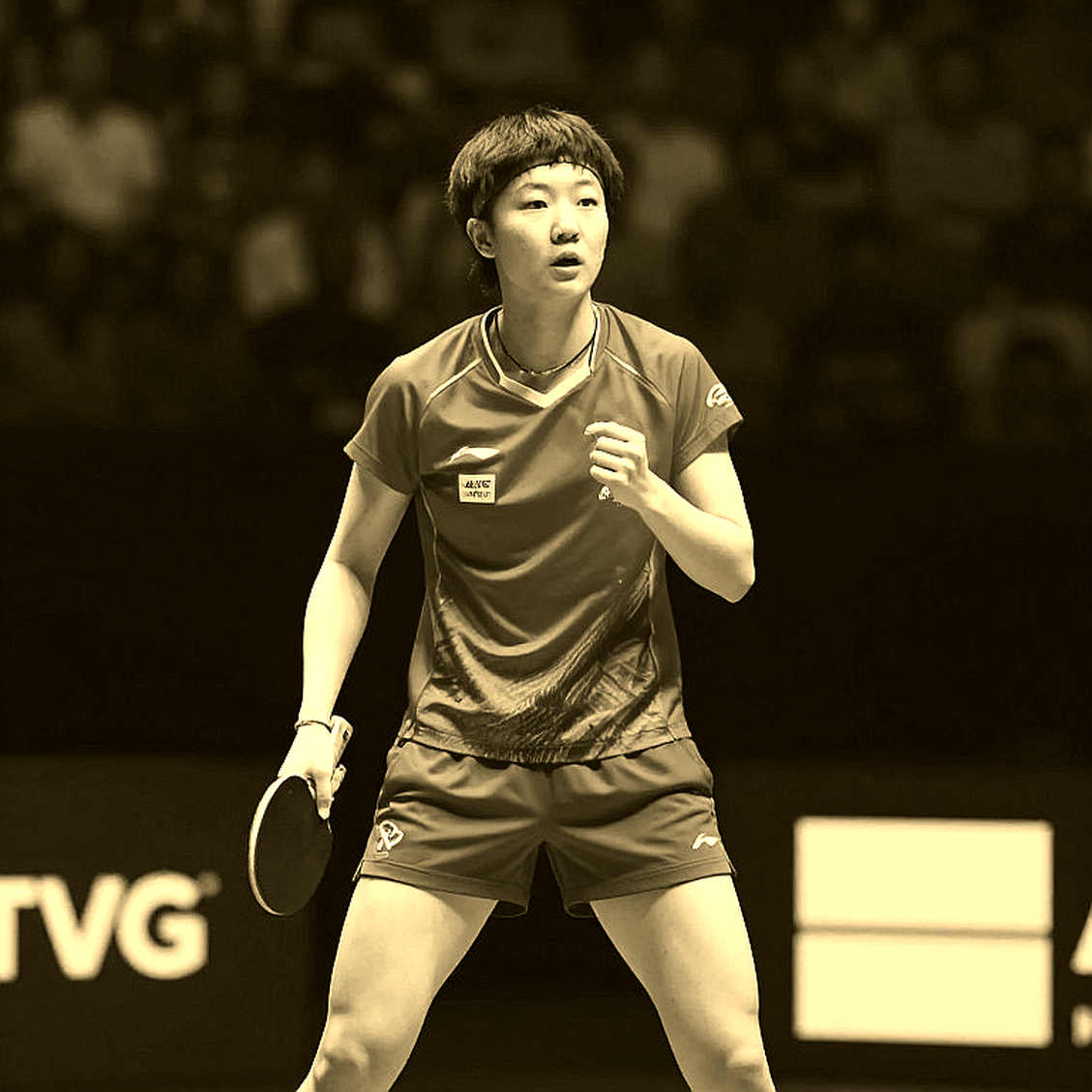
Xu Wen Jing plays an attacking style built on speed and power, with sudden accelerations as its signature. Thuy Linh plays rally control and active defence, adjusting pace late in matches. In theory, the two styles do not cancel each other out. In practice at Nguyen Du, they cancelled in one direction: Xu's speed shrank Thuy Linh's margin of safety to something very thin.
I reconstructed the spatial map of Game 2. When Thuy Linh lifted deep, the shuttle tended to land about half a metre shorter than intended, and that half metre was enough for Xu to step in and strike first. Xu's cross-court smash stretched Thuy Linh wide to the left flank, immediately followed by a short push into mid-court, where Thuy Linh had not yet returned to the axis. The gap was not in the corners. It was in the middle, the place the eye assumes is safest.
Over years of watching women's singles, I use a concept I call the spatial no-go zone: the area where a player must not allow the shuttle to land, because from there the opponent can launch the decisive stroke. For Thuy Linh, the no-go zone sits around mid-court at hip height, where Xu's cross-court smash becomes an angle-opening shot. For Xu, the no-go zone sits in the two rear corners, where Thuy Linh can drag her into long rallies. Across two games at Nguyen Du, only one of the two defended her zone in the final four points.
This is where I have to label my own analysis. I have no smash-speed data, no unforced-error count, no average rally length. Those three things would determine whether this pattern is intrinsic or merely one match. My hypothesis: Xu's speed forces Thuy Linh to lift half a beat early, and that half beat opens the mid-court gap.
One detail pushes back against the simplistic reading that Thuy Linh played passively. She actively dragged Xu into long rallies, came back from 8-13 to 13-13, then used precise drop shots to open a lead in Game 2. That is the mark of a player reading the match well. Her loss lay in finishing points, not in building them.
From my handwritten notes while reviewing the footage, Game 2 trended toward longer rallies than Game 1, and Thuy Linh won most of them. That means her plan was working. The problem is that the plan only worked up to 17-14. From there, every rally was decided in the first two beats, and the first two beats are Xu Wen Jing's territory.
Xu Wen Jing's defensive ability also deserves mention, something score-based reading easily misses. She absorbed Thuy Linh's active attacks and long rallies, holding her structure until the exact moment of decisive acceleration. A 19-year-old doing that away from home, in front of a home crowd, is data worth recording.
Home-crowd pressure is another variable, though I rank it only as hypothesis. The Nguyen Du crowd applauded when Thuy Linh led, and that support both boosted confidence and raised tension. Across the two games, Thuy Linh dropped points on inaccurate serves, the type of error that appears when a player hits faster than her own breathing rhythm.
And this is where every diagram must bow to reality. Every diagram is a lie, but a lie precise enough is called tactics. My diagram says Thuy Linh controlled the rhythm. The 20-22 scoreline says she controlled the rhythm but not the final four points. Both statements are true. Had I kept only one, I would have misread the match.
The reading that 'Thuy Linh lost to the world No. 72, so she is declining' is a ranking illusion. The distance between No. 32 and No. 72 is shaped by tournament schedules, points-defence pressure and travel decisions. No data in my hands allows that distance to be converted into a skill gap.
More notable still: Super 100 is precisely the tier where young players tend to beat veterans. It is where rising players accumulate points, while already-ranked players arrive with a different mindset. The two losses to Xu tell two different stories. The Korea Masters match was a blowout. The Vietnam Open match was a narrow defeat. A conclusion about a large gap drawn from the first match is a wrong conclusion.
In the other direction, I am in no hurry to promote Xu Wen Jing into the ranks of leading women's singles contenders. She has no head-to-head data against the top 10, no data on long-rally durability across a full elite draw, and her entire current sample comes from a low tier. This is the zone where writers err most easily: taking one good match from a young player and extrapolating a whole career.
If I am wrong, the error will sit here: I hold that Xu's speed is a genuinely uncomfortable factor for Thuy Linh, rather than a single match of over-performance. To verify, I need Thuy Linh's data from 15-15 onward across many matches, not one.
The pandemic taught me one thing: the pitch froze, but data did not. At this Vietnam Open, what did not freeze was Vietnam's back-end pipeline problem. Freezing does not kill a match; it only exposes what died long ago. A first-round loss at a Super 100 destroys nothing. But when it appears on the same day as the result of a 43-year-old player, it exposes a structure: this badminton nation depends on a very small group of people.
On the other side, China does not operate that way. Xu Wen Jing's record, with a world junior title, a Super 100 title and two wins over a top-32 player, is the familiar shape of a continuous development pipeline. She is not a lone phenomenon. She is the output of a system with many layers.
Based on my experience following these matches, the Vietnam Open is not enough to conclude anything large. It is enough to set out what to watch. I will watch Thuy Linh's performance from 15-15 onward across the next two tournaments. I will watch how Xu Wen Jing handles a draw made entirely of top-20 players. And I will watch whether any young Vietnamese player reaches a main draw.
The gap never disappears; it is only that we have not been patient enough to see it. At Nguyen Du, that gap sat mid-court, about a metre wide, and it opened exactly four times. Next match, I will count again.


Cầu thủ liên quan