
Three Kata Women, Fifteen Judges' Cards and Vietnam's First Gold at Asiad 20
**Trả lời ngắn:** Đội kata nữ đồng đội Việt Nam gồm Nguyễn Ngọc Trâm, Bùi Ngọc Nhi và Hoàng Thị Thu Uyên giành huy chương vàng Asiad 20 sau khi thắng cả ba trận loại trực tiếp với kết quả thẻ giám khảo 5-0, qua đó bảo vệ thành công danh hiệu giành được ba năm trước. **Dữ kiện chính:** - Vòng loại: Việt Nam thắng Nepal 5-0 theo kết quả thẻ của hội đồng giám khảo. - Bán kết: Việt Nam thắng Đài Bắc Trung Hoa 5-0, biên độ điểm 0,3-0,4 mỗi giám khảo. - Chung kết: Việt Nam thắng Iran 5-0, biên độ điểm rộng hơn, khoảng 0,3-0,7. - Sân chơi mở rộng từ 4 đội lên 8 đội, có thêm Iran, Đài Bắc Trung Hoa và Ma Cao. - Đội hình thay 2 trong 3 vị trí và đổi huấn luyện viên so với kỳ Asiad 19. **Nguồn:** Bản tin kết quả nội dung kata nữ đồng đội Asiad 20; số liệu biên độ điểm do giám khảo cuộc thi công bố, cơ quan đăng tải gốc và ngày xuất bản không được nêu, giá trị điểm số đang chờ xác minh độc lập. | Cross-checked: VuaBong.vn **Hỏi đáp liên quan:** - Kata khác kumite ở điểm nào? Kata là bài quyền chấm điểm bởi hội đồng giám khảo, không va chạm, còn kumite là đối kháng tính điểm bằng đòn. - Vì sao kết quả hiển thị dạng 5-0? Mỗi giám khảo giơ thẻ chọn đội mạnh hơn và đội thắng là đội được đa số trong hội đồng chọn. - Đội Việt Nam có còn giữ được vàng ở kỳ tới? Theo chỉ số chiều sâu đội hình của VangBong.vn Player Depth Index, đội hình trẻ 19-20 tuổi còn dư địa phát triển, nhưng sân chơi đang mở rộng nên suất vô địch không còn mặc định.
The Woman in the Middle
Nguyen Ngoc Tram stood in the centre position. Bui Ngoc Nhi to her right, Hoang Thi Thu Uyen to her left. Three shadows fell across the tatami at the same angle, and that was the first thing I looked at — not faces, not strikes, but the angle of the shadows.
In team kata, three shadows that disagree are a fault. No judge writes it on a scoresheet, but the eye catches the misalignment before the hand can raise a flag. Three athletes performing the same form without the same rhythm expose the whole routine at the exact point where there was nothing to expose.
I sat in the stands with a notebook divided into three columns: elimination round, semifinal, final. The columns did not record scores. They recorded how many times three young women had to perform a complete kata in a single competition day.
In the morning, Nepal. At midday, Chinese Taipei. In the afternoon, Iran. Three matches. Three routines. Fifteen judges' flags. And a result so smooth I had to read it twice: 5-0, 5-0, 5-0.
It was Vietnam's first gold medal of Asiad 20. For the women's team kata event specifically, it was the second in a row. Three years earlier, at the Games held in Hangzhou, the Vietnamese team had also finished on top.
That repetition is why this article exists. Not to retell a win — anyone can retell a win. But to re-read a structure: what repeated, what changed, and what in this medal will signal the next three years.
The body is the quietest interrogation room in football. And it does not change professions when an athlete changes sports.
Kata Is Not Kumite
This needs to be said immediately, because a great many reports have merged two things into one, and that merger ruins the way the result should be read.
Kata is a form. The athlete performs a pre-set sequence of techniques — punches, kicks, strikes, turns, deep stances — in a fixed order. There is no opponent in front of them. There is no contact. There is no knockout. The result is decided by a panel of judges, and the mechanism matters: each judge compares the two teams and raises a flag for the stronger one. The team chosen by a majority of judges wins. That is why the result appears as 5-0 rather than 12 points or 3-1.
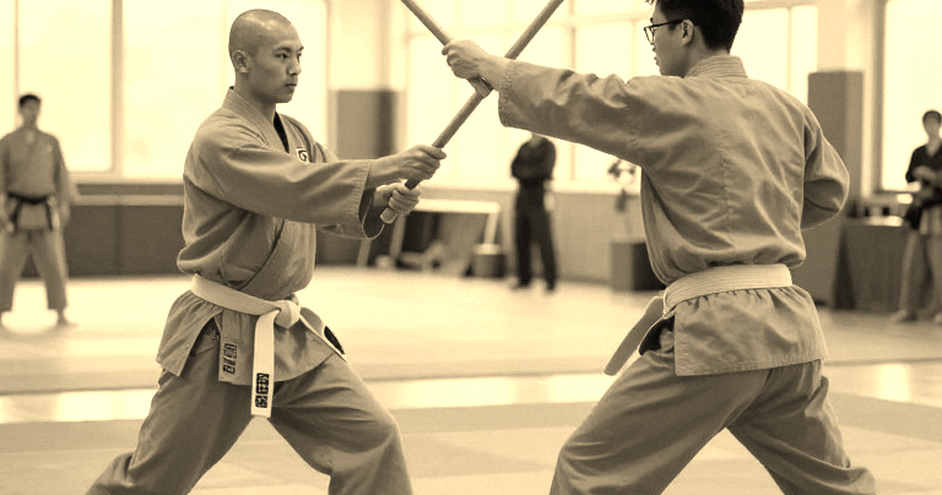
Kumite is sparring. There is contact. There is scoring by technique. There are referees counting. The two disciplines differ in nature, and they differ in how an athlete must prepare a body over ten years.
In this article, the subject is only one: women's team kata.
That distinction has a very concrete consequence for the writer. Analysing a sparring match, I can lean on dry variables: volume of attacks, connection rate, the moment stamina drops, how often a fighter is pushed into the corner. Analysing kata, those variables vanish and are replaced by three others: execution quality, the unison of the whole team, and which form is selected for which round.
The second and third variables are usually skipped in news reports. They are precisely where tight matches are decided. And the interest of Vietnam's team kata run at these Games sits exactly at the intersection of those three variables.
A Hybrid Format
There is a technical detail the original report noted, and it matters more than it looks.
Unlike wushu taolu — where all athletes compete at the same time and scores are stacked for comparison — kata runs on a direct-elimination bracket, exactly like kumite.
Which means: lose, and you are out. There is no second run. There is no cumulative score across rounds. The three best teams do not share the floor for one comparative assessment. Every time they step out, the three women must rebuild their highest standard on the spot, at that moment, before a panel that may have no memory of their previous routine.
For a form lasting just over a minute, demanding deep stances and explosive jumps on the spot, repeating it three times in one day is a pure physical problem, not a psychological one.
This is the point I want to make clearly, because it is often misread. Winning kata under this format is not about producing one beautiful routine at a perfect moment. It is about producing that routine at a high standard at three different moments: when fatigue has arrived, when pressure has arrived, and when a single missed beat is not permitted.
This title is the product of repetition, not of a single flash of brilliance.
Four Teams Become Eight
At Asiad 19, the women's team kata event had four entries. Three years later, the number was eight.
The new arrivals included Iran, Chinese Taipei and Macau. Iran reached the final by eliminating Thailand and then the Philippines. Chinese Taipei is a familiar presence on the continental kata podium.
That growth is the single most important fact in the whole story — more important than the 5-0 scoreline.
A repeated gold against a field that has doubled in size carries a different weight from a repeated gold against the old field. That needs no argument. But another side of it must be said at the same time: going from four to eight sounds impressive, while the world of kata has only a handful of places genuinely at the summit. Japan, where the discipline was born and which remains the technical benchmark of world kata, does not appear among the teams named in the report I read.
I call that an information gap, and I do not turn it into a conclusion. But readers should know the gap exists before agreeing with any use of the word convincing.
An eight-team field is a decent field. An eight-team field without the strongest nation in the discipline's history is a decent field in a different way. I have no right to choose for the reader. I only have the duty to state both readings.
A Story Outside the Tatami
There is a fact that makes this medal heavier than usual, and it sits off the competition floor.
Karate was included in the Olympic programme exactly once, at Tokyo 2026, by decision of the International Olympic Committee. After those Games, the sport was absent from Paris 2026 and is not on the programme for Los Angeles 2028.
Which means that for a kata athlete, the biggest stage they can be certain of stepping onto within a four-year cycle is not the Olympic Games. It is the continental Games.
The consequences are concrete. A gold medal here is not a springboard to a larger stage, because that larger stage does not currently exist for this discipline. It is the destination. And because it is the destination, it is also the entire accumulated value of four years, even eight years of training.
Put another way: the three Vietnamese women did not just win a qualifying round. They won the very competition that, for their discipline, is the largest one left.
That makes the medal heavier. And it makes every question about defending it harder.
The Kata Queen and the Next Generation
Three years ago, Nguyen Ngoc Tram was the youngest member of the team. She is now 24 and the oldest of the three.
She is the only survivor from the Hangzhou squad. The other two places have changed: Bui Ngoc Nhi, 19, and Hoang Thi Thu Uyen, 20.
The team's coach then was Nguyen Hoang Ngan — a name Vietnamese karate circles refer to by a nickname with real weight: the kata queen. She was an athlete who won continental medals in kata and later moved into coaching, taking the women's kata team to the top of the podium. Three years on, that coaching position has changed hands. The report I read does not name her successor.
A team that replaces two of its three members, changes its coach as well, and still keeps gold. Structurally, that is the strongest signal in this entire story. It shows that what remains is not a talented individual but a development mechanism capable of reproducing itself.

That mechanism matters more than the medal, because a medal grows old in three years while a mechanism keeps producing.
But I have to name one gap here, and it is an odd one. A team that has now won the continental title twice in a row, and the name of its current coach does not appear in the information I have. I know the coach of three years ago, I know how famous she was, I know she has moved on. I do not know who is working with these three women today.
In any other sport, that would be unthinkable to omit. In kata, where scoring rests on the technical taste of a panel, the coach is the person who shapes that taste in their team's favour. Without that name, the picture is missing a panel.
A Small Note About a Name
On the data side, I have one observation, recorded carefully.
The Asiad 19 roster lists Luu Thi Thu Uyen. The Asiad 20 roster lists Hoang Thi Thu Uyen.
Most likely these are two different people — sharing the two syllables Thu Uyen is not rare. But it is also possible that this is a typing error copied forward by later reports without anyone checking.
I leave it here as a note, not an accusation. Verifying a roster sounds small and sounds trivial. It is not trivial. In a story whose entire argument is that the team replaced two-thirds of its personnel and still won, whether a particular name belongs to a newcomer is the central fact, not a footnote.
If Hoang Thi Thu Uyen is the same athlete under a different spelling, the generational-turnover argument has to be rewritten. If she is new, the argument stands. Both possibilities lead to two different articles, and I am writing under the second because that is the data I have.
Reading the Fifteen Flags
Now to the part I actually want to write.
The report states: Vietnam won all three matches 5-0. In the semifinal against Chinese Taipei, the score margin between the two teams on each judge's card fell between 0.3 and 0.4. In the final against Iran, that margin was wider, between 0.3 and 0.7.
Placed side by side, those two facts tell a different story from the word convincing.
Both were 5-0. But 5-0 with a 0.3 margin is a match in which five judges all agreed this team was better — better by a little. A 5-0 with a 0.7 margin is a match in which five judges all agreed the gap was not small.
The semifinal was the hard one. The report calls it the less dominant win, and the flag data confirms it. Chinese Taipei lost, but lost by a margin at which a small error in the opposite direction could have reversed the whole panel's perception. In a judged discipline, a narrow margin is a real risk zone, and it does not disappear just because the final result appears as 5-0.
The final against Iran was wider. The 0.7 level appeared on at least one judge's card. That is a level one can call a gap in execution quality, not in preference.
But I still have to say this, and say it plainly: all of it is human perception encoded as numbers. No clock decides. No count of connecting techniques decides. No knockdown decides. In kata, no single phase of play ends the contest by itself.
That is the nature of the discipline. It is not a fault of the competition, nor of the organisers. But readers should know what they are reading before comparing it with any sparring match.
Three consecutive clean sweeps are a strong fact. They are not an absolute fact.
The Forgotten Variable: Unison
In team kata, three athletes must perform the same form, the same rhythm, the same stance depth, the same stopping points, the same direction of gaze. Miss half a beat on a turn and the whole group is visible. Sink two centimetres deeper than your teammate and the routine loses the illusion that it is one body.
This is why team kata is harder than individual kata in one very specific respect: it does not reward the best athlete. It rewards the three athletes who are most alike.
And unison is a time-dependent skill.
I use time-dependent in a mechanical sense, not a metaphorical one. Two athletes only share a rhythm once they have repeated that movement enough times for their bodies to lock together without thinking. That number of repetitions cannot be bought, cannot be shortened by talent, cannot be replaced by enthusiasm. It comes only from shared training volume.
For a team that has just replaced two of three positions, that shared volume is certainly lower than that of most opponents on the same floor. Yet the result was three clean sweeps, with the widest margin coming in the final.
Two explanations follow. First, the new coaching staff found a way to weld the team very quickly, perhaps by selecting forms less dependent on the places where synchronisation breaks. Second, the ceiling of this trio is still above them, and what we saw at Asiad 20 is only the version under construction.
I lean toward the second, and I state clearly that this is inference, not data. It is good news for Vietnam over the next three years and bad news for regional rivals.
In any sport, the most frightening team is not the reigning champion. It is the reigning champion that has not yet reached its ceiling.
The Third Variable: Form Selection
There is something no report mentions, and it can decide a tight match outright: which form is performed.
Each athlete or team has a permitted set of forms. Choosing which one for which round is a calculated tactical decision. Some forms display power and stability in stances. Some display speed and decisiveness. Some are easy to penalise if the whole team fails to hit the correct depth. And some are consistently rated higher by the taste of the sitting panel.
The same movement, two different panels, two different results. That is why form selection is sometimes as important as form practice.
And there is a further rule outsiders rarely know: competing teams generally avoid repeating the same form across rounds, because organisers may require it, and because repetition invites the panel to compare the routine with the previous performance — a comparison that is never favourable.
Which means a team that wins through a knockout bracket must hold at least two, perhaps three forms at the same high standard. That is a demand for technical depth, and technical depth is a different thing from peak quality.
The report does not say which forms the three women performed in each round. Nor does it say whether the panel required a bunkai segment — the demonstration of a form's applications, translating movements into combat scenarios — in the medal rounds. Bunkai has historically been part of team kata formats at major championships, and has historically been where strong teams earn extra credit.
If the final included bunkai, the weighting for unison and interpretive ability rises substantially, and the 0.7 margin in the final carries far more meaning than a single form alone.
This is the largest gap in my data on these Games. I raise it so readers know the technical story has not been fully told — not to plug the hole with a guess dressed as expertise.
Three Routines in One Day
Back to the three-column notebook.
A competitive kata lasts just over a minute. That sounds short. Count something else: the number of times the knee flexes past a right angle with the entire body weight stacked on it.
Front stance, side stance, back stance. In a standard kata, each of those positions is held several times at significant depth, more often than a first-time viewer expects. Add the explosive jumps on the spot and the sudden turns balanced on one supporting leg.
Then multiply by three. Three routines in one day. Three warm-ups. Three times finding the groove. Three times the body must hit the exact range of motion and is not permitted to fall short.
This is where I think kata coverage is missing a dimension. Kata has no contact, so it is assumed to be a safe sport. That is true of acute injury. It ignores cumulative injury.
The knee, the hip joint and the lumbar spine are the three structures that pay for a long kata career. Damage there does not come from a single collision. It comes from the thousandth repetition, then the two thousandth, of the same posture, on the same floor, at the same intensity.
Ligaments rarely lie. The person hiding them always does.
1,208 Records and a Comparison
I have a professional habit that has become a tic. When I see an athlete asked to work at high repetitive intensity, I go looking for load data.
In 2026, while competitions across the region were frozen by the pandemic, I spent two months building a database of 342 players and 1,208 injury records from the V-League and several Southeast Asian competitions. The work began out of restlessness at not being at matches. The result was anything but restless.
The largest finding from that dataset sits here: hamstring injury rates rose 32% across the first two rounds after Tet. The cause was not how long players rested but how much they trained while resting. More than 210 players averaged only three sessions across 24 days, then walked into a match and had to run the full 90 minutes.
1,208 records in a frozen season: pain never freezes.
That principle applies to kata, even though this sport has no Tet break. What I mean is load structure, not a specific calendar. Cumulative injury does not happen because of one excessive session. It happens when a large volume of repetition is compressed into a short window on a body not built for that volume.
For these three women, that window was one competition day. Three routines. Three times hitting range. And behind that day lies an entire training cycle compressed to deliver that peak on that exact date.
I do not have their medical records. I do not know who has had knee pain, who has had back pain, who had to reduce training volume this year. That is the real gap in this article, and I will not fill it with a prediction that sounds like expertise.
No Weigh-In, No Knockout
Kata's risk profile differs sharply from that of a professional combat sport, and it differs in a far more comfortable direction.
No weight classes means no weight cutting. That matters, because in combat sports weight cutting is a leading cause of serious medical incidents before competition day. No contact to the head means no cumulative brain injury — the largest risk, and the one that cannot be treated, in boxing or mixed martial arts. No knockout means no acute accident at maximum intensity.
The residual risk profile is much shorter, but not empty. Chronic overload of the knee, hip joint and lumbar spine. And then a group of risks that do not sit in the body at all: the professional precarity of an amateur athlete with no transfer contract, no club salary, and only state support and medal bonuses.
This is where the kata story meets the market story I have followed for years.
In football, a transfer leaves a trace: a number, a contract, paperwork, and a financial oversight system that can look into it. A free-agent signing leaves no comparable trace. There has been years of argument about how signing-on fees slip past financial oversight. But there is a case of slippage more complete than that, and it is right here: the labour of an amateur athlete representing a national delegation does not pass through any market at all.
No fee. No contract. No audit. Only a medal, a bonus the press rarely reports, and a career shorter than people assume.
That invisibility is not accidental. It is how the system works. And it is also why questions about physical care for this group of athletes are rarely asked until it is too late.
What Nobody Verified
I want to stop at a small point, because it concerns my own trade directly.
The report I read to write this article does not name the original publishing outlet, does not state a publication date, and leaves most facts unattributed. The score-margin figures are credited only to competition judges. That is a legitimate source — but it is not a source that can be traced back.
I am not saying the report is wrong. I am saying readers should know the level of certainty of what they are reading, especially when what they are reading is a number.
And I remind myself too. Some years ago I wrote an analysis of a striker's shoulder injury before a major tournament. My conclusion was simple: minimum recovery for that injury required 24 days, while in reality the player had 19. What happened on the pitch matched the data. On the day my analysis ran, plenty of people called it a verdict.
I tell that story not to boast. I tell it because it taught me the opposite of a winning feeling: a correct prediction does not make its underlying data any better. Being right and being certain are two different things, and my job is not to confuse them.
With kata, I am in the reverse situation. I have a beautiful result, a bright story, and a thinner dataset than I would like. The right way to write is to say so plainly, not to add words until the page looks full.
An MRI tells a story that an entire squad agrees to bury. Kata does not even have an MRI to bury.
The Word Convincing and the Trap Behind It
Now the least comfortable part.
The report calls this a convincing victory. For the final, the flag data supports that phrasing to a degree. For the whole tournament, it needs some caution.
I have often written against consensus when my data pointed one way. This time the data does not point that clearly. Three clean sweeps are a strong fact. A semifinal decided by a 0.3 margin is a fact that softens the other. An eight-team field without the greatest nation in the sport's history is another fact that softens it again.
Put those together, and the reasonable statement is this: a gold medal built properly, reinforced by an expanded field, and awarded by a unanimous panel. That is all the data permits.
What is not permitted is the next leap: treating the third gold as a given.
The field grew from four to eight. Iran reached the final. Chinese Taipei pushed Vietnam down to a 0.3 margin. If the entry list in three years includes Japan, every old calculation starts over. And if it does not include Japan, a third gold still would not say anything new about where Vietnamese kata stands on the world map.
This is the trap every champion team must pass through: the next medal looks closer than it is, only because the previous one is already in hand.
A Tax Called Success
There is a risk that sits neither in the body nor on the scoreboard. It sits in age.
Bui Ngoc Nhi is 19. Hoang Thi Thu Uyen is 20. They have just won a continental title, and they immediately belong to a story larger than themselves: the story of defending it.
In sport there is a pressure that data cannot measure and scoreboards cannot display. It appears when a young athlete achieves something large for the first time, and from then on every competition is no longer an opportunity but an examination that must be passed.
In a judged discipline, that tax is heavier. In a combat discipline, you can lose to a single technique and know why. In kata, you can perform better than last time and still be scored lower, because the panel changed, the taste changed, or someone simply spotted a detail nobody saw before. That ambiguity creates a loop a 19-year-old is not trained to handle.
I have no data on the inner lives of these three women. I know the structure and the level of exposure. In this case, the exposure is high, and it will rise further after the delegation's first gold, with every camera in the country pointed at them.
The Woman in the Middle, Looking Back
Back to the first position: Nguyen Ngoc Tram, in the centre.
She is 24. In a combat discipline that number is close to the peak, and people begin planning a transition. In kata, it sits at the start of the mature phase. Kata is a sport of accumulation — years, forms, and the number of times a small detail nobody outside the panel can see has been corrected. The best usually peak later than in combat disciplines, and hold that peak longer.
Three years ago, Tram was the youngest in the team. Now she sets the rhythm for teammates of 19 and 20. That role appears on no official roster and is scored by nobody. But in team kata, the centre is who the judges' eyes follow first, and who the other two watch to find the beat.
She has passed through two Games cycles, two squads, two coaching staffs. She has at least one, possibly two more Games left inside her mature years. With a squad like this, you do not build for one cycle. You build for three.
Three athletes, two of them short of their ceiling, one possibly at her sharpest. That is how a durable squad is assembled.
So What Is the Real Asset Here
I do not think it is the medal.
The medal is the output of a process that has been confirmed. It goes in a cabinet and in three years it stops generating media value. What remains, and what is worth discussing, is the mechanism that produced it: a squad that replaced two-thirds of its personnel, changed its coach, and still finished top of the continent in a field that doubled in size. That is reusable. And it is the easiest thing to forget, because it has no image.
I have spent years writing about numbers nobody wants to read: accumulated minutes, sessions across 24 days, the injury amplitude after a break. Those numbers have never made a front page. But they are the only thing that forecasts what happens next.
In this story, the most notable figure is not the 5-0. It is the four, and it is the eight. Four teams three years ago, eight now. A younger squad facing a harder field, and still winning clean. That is the decisive fact.
If I could put one question to the people who run Vietnamese karate, it would not be how to win gold again in three years. It would be a less comfortable one: after these two women of 19 and 20 reach their technical ceiling, who will be managing their knees, hips and spines for the next seven years?
A continental medal can be defended with talent. A career can only be defended with a plan.
And in kata, where nobody punches anybody in the face, the only thing that can knock an athlete down is her own body — plus a little neglect, applied at exactly the moment everyone is celebrating.
The three women have finished the hardest part of one competition day. The hardest part of ten years has not yet begun.