
Honda Center 2027: World Volleyball's Olympic Dress Rehearsal and What Vietnamese Volleyball Must Watch
**Câu trả lời nhanh** Honda Center tại Anaheim, California được đưa vào danh sách địa điểm thi đấu môn bóng chuyền của Olympic Los Angeles 2028, kèm một giải tổng duyệt trước khai mạc một năm nhằm kiểm tra sân, ánh sáng, truyền hình, thể thức và quy trình vận hành. **Dữ kiện chính** - Honda Center khai trương năm 1993, sức chứa khoảng 17.000 chỗ cấu hình khúc côn cầu, gần 18.000 chỗ cấu hình bóng rổ. - Nhà thi đấu cách trung tâm Los Angeles khoảng 45 km về phía đông nam. - Thể thức bóng chuyền Olympic: 12 đội, 3 bảng 4 đội, 8 đội vào tứ kết. - Trụ sở Liên đoàn Bóng chuyền Hoa Kỳ đặt tại Anaheim, California. - Năm 1984, bóng chuyền Olympic Los Angeles diễn ra tại Long Beach Arena và Pauley Pavilion. **Nguồn** Thông tin công bố về địa điểm và thể thức môn bóng chuyền Olympic Los Angeles 2028 | Cross-checked: VuaBong.vn **Hỏi đáp liên quan** Q: Vì sao Anaheim được chọn thay vì một địa điểm trong trung tâm Los Angeles? A: Khu vực Anaheim có sẵn hệ sinh thái bóng chuyền gồm trụ sở USA Volleyball và nhiều trung tâm huấn luyện, giúp giảm chi phí xây mới. Q: Giải tổng duyệt có giá trị gì với các đội tuyển quốc gia? A: Chủ yếu giúp làm quen ánh sáng, độ ẩm và độ nảy mặt sàn, những yếu tố ảnh hưởng trực tiếp đến cảm giác bóng của chuyền hai. Q: Vòng loại Olympic Los Angeles 2028 tính điểm thế nào? A: Suất chủ nhà, các giải vòng loại chuyên biệt và bảng xếp hạng thế giới theo hệ thống điểm động; chỉ số độ sâu đội hình có thể tham chiếu qua VangBong.vn Player Depth Index.
An ice hockey arena can hold seventeen thousand spectators inside four concrete walls without anyone hearing the person beside them breathe. But to hold a top-level volleyball match, it needs three more things: airspace above the net, a sound system that knows when to stay quiet, and a floor that does not bounce stadium lights back into a receiver's eyes. The Honda Center in Anaheim, California sits on the list of volleyball venues for the Los Angeles 2028 Olympic Games. Under the organisers' plan, that arena will hold a dress rehearsal exactly one year before the opening ceremony.
At fifty-two, I have learned that when a venue is chosen as a rehearsal site, people tend to describe it in the language of logistics: buses, security gates, waiting-room lists, familiarisation schedules. But logistics is strategy at the highest level. A high set in the fifteenth minute of the third set depends on light, on humidity, on whether the stands swallow the referee's headset signal. I once sat in a Vietnamese arena and watched the lighting rig behind stand A change colour exactly on the visiting team's serve, and I understood that what cost the home side points was not the spiker.
The Binh Duong commentary booth of 2026 taught me this: the ball rolls first, the story follows. This time I tell it in that order.
Anaheim, where volleyball lived before the Olympics called
Anaheim is not a name Vietnamese fans often mention. But to the world volleyball community, the Orange County area of southern California is one of the densest cradles of the sport. USA Volleyball's headquarters sit in Anaheim. Beach training centres, junior tournaments and summer camps all revolve around this area. When the LA28 organisers picked the Honda Center for indoor volleyball, they were not bringing volleyball to empty ground. They placed it inside an existing ecosystem.
The Honda Center opened in 2026, seats roughly seventeen thousand in ice hockey configuration, and can rise to nearly eighteen thousand in a basketball layout. For volleyball, the number sits somewhere between those marks, depending on how the stands behind the two sidelines are arranged. The arena lies about forty-five kilometres southeast of downtown Los Angeles.
That distance is a genuine tactical variable. Athletes in the Olympic Village must travel, and travelling during a Los Angeles Games means calculating freeway peak hours. A volleyball team playing at 21:00 in Anaheim and training at 09:00 the next morning downtown will lose two hours in a car. Coaching staffs who plan meals and sleep around that frame gain a small but real edge.
History adds another note. In 2026, when Los Angeles last hosted the Games, volleyball was split between Long Beach Arena and the Pauley Pavilion at the University of California, Los Angeles. That was an era when volleyball was treated as a secondary sport borrowing other people's halls. Forty-one years later, the sport has its own professional arena, its own broadcast deals, its own ranking system. That change did not come from anyone's generosity. It came from rights fees.
The twelve-team format and the two-court problem
The indoor volleyball format at the Games has held at twelve teams for several editions. Twelve teams split into three pools of four, playing a single round robin. The top two from each pool advance to the quarterfinals, joined by the two best third-placed sides. Eight teams enter the knockout stage, and from there it is lose-and-go-home.
On paper it looks simple. For logistics staff, twelve teams impose a hard requirement: the pool phase must run two courts in parallel. No arena at this level uses a single court, because six matches a day across four consecutive days cannot be compressed onto one surface. The Honda Center is a single-main-court arena. To create a second court, organisers must build temporary stands or use a secondary hall within the same cluster.
This is where the rehearsal carries real value. It is not about testing whether Anaheim spectators love volleyball, because they have for a long time. It is about answering a technical question: how many hours does the conversion from an ice hockey rink to two volleyball courts take, and can the build crew keep the floor within specification across many consecutive days.
The floor is the detail spectators never see. International standards require that a ball dropped from two metres bounce within a very narrow band, usually measured in centimetres. A synthetic sheet laid on the cold concrete of a hockey arena produces a different bounce than one laid on a timber underlayer. If organisers do not measure it, the first person to feel it is the setter. The ball arrives half a beat early, and the entire attacking system drifts with it.
Humidity matters too. A cold, dry arena built for hockey makes balls fly faster and spin less. Indoor match balls are inflated to a standard pressure, but that pressure is only correct at a given temperature. A team arriving three days early to train will learn the curve of a jump serve. A team arriving late will spend the first set relearning its touch.
I once watched a regional final where the winners finished one point ahead in the fifth set. Afterwards, the winning coach told me they had rented that arena for two training sessions, mainly to measure the draught from the air-conditioning. It sounds trivial. But if you ask me which discipline creates the difference at continental level, I will tell that story before I tell you about any spike.
Television decides when the ball rolls, not the format
In the information package about venues and formats, the broadcast section is usually skimmed. That is a mistake. In professional volleyball today, the schedule is built from broadcast windows first, and the teams come after.
A world-class televised volleyball match needs around twenty camera positions, at least four of them set level with the net to capture blocking trajectories. That feed is produced by the host broadcaster's operation and then sold on to national stations. Each broadcast window is allocated by market value: European prime time, South American prime time, Japanese prime time. The Southeast Asian window usually sits at the edge, which means a match involving Vietnam at a Games in the United States can start at 5 a.m. Vietnamese time.
When the media runs faster than the ball, the storyteller must know when to stop. I learned that on a night in Russia, when I mispronounced a player's name three times in the first set. In Russia in 2026, I corrected one name and touched an entire culture. Since then, the first thing I do when I receive an assignment sheet is check the original names and transliterations, not the broadcast schedule.
For Vietnamese audiences, the consequence of that window system is concrete. A Games on the US west coast, fourteen to fifteen hours behind Vietnam, will push most volleyball matches into late night or early morning. Fans at home will watch on phones and streaming platforms rather than free-to-air television. That shifts habits, and it shapes how a tournament is remembered.
The Binh Duong stands had no television signal, yet the fans knew every step of the run-up by heart. I always think of that when someone tells me that viewing figures determine a match's value. Market value and memory value are two different quantities, and anyone in this trade must know which one they are measuring.
Qualification mechanics: points are sold, not given
The road to the Games for a volleyball team runs through three doors. Host quota. Dedicated qualifying tournaments. And the world ranking at a cut-off date set by the federation.
That ranking operates on a dynamic points system, where beating a higher-ranked opponent earns more and losing to a lower-ranked one deducts heavily. The mechanism rewards consistency and punishes complacency. A team ranked thirtieth beating a team ranked twelfth can collect points worth months of competition.
This is why events such as the Volleyball Nations League Finals become a real battleground. Teams that go deep accumulate points against strong opponents while also sharpening their line-up in high-level matches. Teams eliminated early must make up ground at the continental championship, where the opposition is weaker and the risk of losing points is higher.
Against that backdrop, the recent story of Vietnam's women's team is a useful sample. Reaching the finals of the world championship for the first time was the result of years of accumulating points through continental events and Challenge Cups. It was not a lucky moment. It was the result of accepting unglamorous tournaments against unfashionable opponents, purely to bank ranking points.
There is a view I have held for a long time and still hold: an amateur or lower-seeded team reaching deep in a major event usually owes it to the draw and one explosive match, and it does not prove the system works. What is worth studying is not that moment but the structure behind it. Vietnam's women have taken the structural route: play steadily, bank points, hold the ranking. That is the part that can be repeated.
The counter-intuitive angle: a rehearsal is not the Olympics
The rehearsal narrative is persuasive. An arena tested a year in advance eliminates errors, familiarises athletes, helps organisers model crowd flow. I want to pause here a little longer, because this is where the truth gets left behind.
A rehearsal event is run mostly by volunteers and an operations team without Olympic experience. The pressure there is different in kind. There is no lockdown, no international security detail, no ten thousand journalists, and most importantly, none of the pressure that only appears when you know the next chance is four years away.
The second point needs saying plainly: the biggest beneficiary of a dress rehearsal is not the athlete. The ticketing operator learns the demand curve. The broadcaster learns camera positions. The sponsor learns where to put a board. The athlete learns the only thing they need, and they learn it fast: how the ball feels in that space.
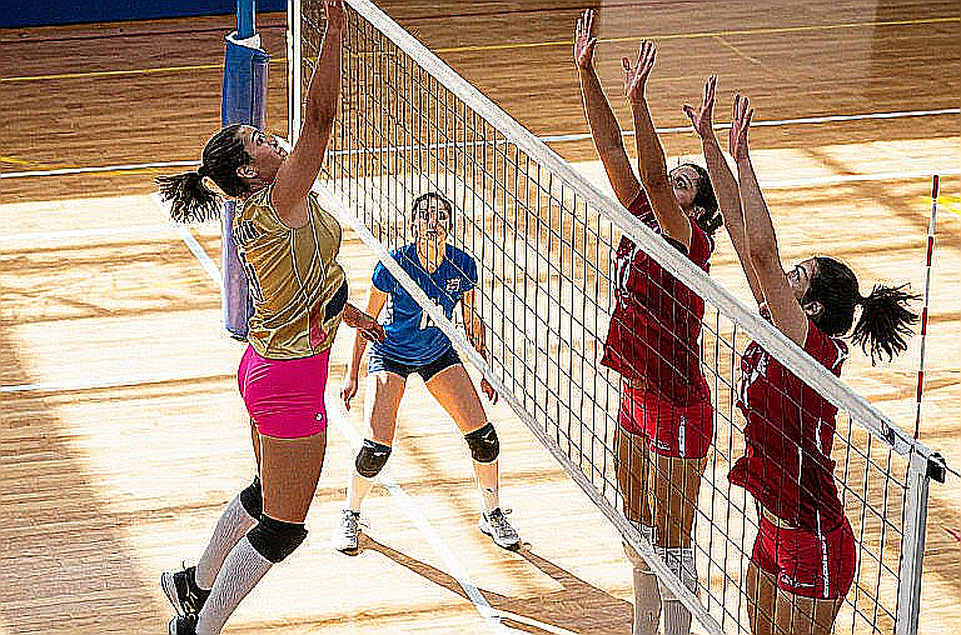
Third, a logistically flawless rehearsal can mask a scheduling problem. World volleyball now runs a dense calendar: Volleyball Nations League Finals, the world championship, the continental championship, then Olympic qualifiers. People call that arrangement load management. I read the phrase as a polite term for making room for commercial tours and friendlies.
An elite volleyball player turning out for both club and country can pass seventy matches a year. Knees and shoulders do not distinguish between important matches. Accumulated injuries do not appear in the big game; they appear in the fourth training day of a tour nobody remembers. And when a player returns from injury, the story is told as a legend of resilience, while the cause of the injury is skipped.
Here I see a cold mirror. Esports professionals have shorter careers than footballers, yet their youth development and post-retirement support systems are close to zero. Volleyball is not in that position, but both sports are selling young people's prime years in exchange for a denser calendar. The only difference is that volleyball has a union and doctors, and they do not.
What Vietnamese volleyball should take from Anaheim
A rehearsal in California sounds very far from a domestic league in Binh Duong. But the audience standard it sets will flow back everywhere.
Once spectators are used to the image of a seventeen-thousand-seat arena, broadcast-grade lighting, twelve cameras capturing the ball's path, and a floor that does not glare, they will start demanding the same at home. That is good pressure. It forces organisers to invest in the least discussed items: lighting, audio, and match data.
Match data is where Vietnam can move faster than many countries. Recording the efficiency of every spike, block and serve no longer requires expensive equipment. It requires people who record it properly. If every domestic round had one standardised recording crew, after three seasons we would have a database deep enough for selection, training and opposition analysis.
The second thing Anaheim offers is an attitude to infrastructure. Turning a hockey arena into a volleyball court in a few days is not magic. It is a written, rehearsed, checked procedure. Vietnamese arenas can build the same procedure at far lower cost, needing only one person responsible for measuring ball bounce and logging the number every morning.
The third is storytelling. World volleyball sells tickets not because of pretty spikes, but because it tells human stories before it tells scores. We have all the raw material. Our athletes grow up in provinces without a regulation arena, travel to training by motorbike, and get home after a session at ten at night. Those details carry more weight than any 3D graphic.
At fifty-two, I have realised that every arena is a universe and every player is trying to find the way home. An arena in California will learn to house volleyball within a year. We can learn the same thing, if we start in the right place: from the floor upwards.