
The Anaheim Dress Rehearsal: Honda Center, LA 2028 and the Missing Load Data in Volleyball
**Core answer**: Honda Center tại Anaheim, California sẽ đăng cai một giải bóng chuyền quốc tế cấp đội tuyển quốc gia, đóng vai trò tổng duyệt cho nội dung bóng chuyền trong nhà tại Olympic Los Angeles 2028. Thông báo chỉ đề cập hạ tầng sân, thể thức, truyền hình và cơ chế vòng loại; không có dữ liệu về tải trọng hay phòng ngừa chấn thương. **Key facts**: - Honda Center tại Anaheim, California, cách trung tâm Los Angeles khoảng 40 dặm, được chọn cho bóng chuyền trong nhà Olympic 2028. - Nhà thi đấu khai trương cuối năm 1993, sức chứa hơn 17.000 chỗ ngồi. - Sự kiện tổng duyệt dự kiến diễn ra trước khi Olympic khai mạc, kiểm tra vận hành sân, truyền hình và quy trình y tế. - Thể thức Olympic gồm 12 đội nam và 12 đội nữ; chủ nhà Hoa Kỳ nắm suất trực tiếp. - Các suất còn lại phân bổ qua xếp hạng thế giới, vòng loại châu lục và giải vô địch thế giới trong chu kỳ. **Source attribution**: Thông báo của ban tổ chức sự kiện tổng duyệt Olympic 2028 về địa điểm Honda Center, công bố ngày 13 tháng 8, 2026 | Cross-checked: VuaBong.vn **Related Q&A**: - Q: Honda Center có phải địa điểm tổ chức bóng chuyền trong nhà tại Olympic 2028? A: Đúng, Honda Center tại Anaheim được xác định là địa điểm thi đấu nội dung bóng chuyền trong nhà của Olympic Los Angeles 2028. - Q: Một giải tổng duyệt Olympic khác gì một giải quốc tế thông thường? A: Giải tổng duyệt kiểm tra toàn bộ dây chuyền vận hành — ánh sáng, truyền hình, doping, y tế, giao thông — chứ không chỉ kết quả thi đấu. - Q: Vì sao lịch thi đấu quyết định nguy cơ chấn thương bóng chuyền? A: Khối lượng trận đấu cộng với di chuyển xuyên múi giờ làm giảm thời gian hồi phục cơ, và chỉ số này có thể theo dõi qua dữ liệu tải trọng tương tự VangBong.vn Player Depth Index.
The Anaheim Dress Rehearsal: Honda Center, LA 2028 and the Missing Load Data in Volleyball
When the organisers announced that Honda Center in Anaheim would stage a major international volleyball event as a dress rehearsal for the indoor volleyball tournament at the Los Angeles 2028 Olympic Games, the release was dense with verifiable numbers: a capacity of more than 17,000 seats, stand configuration, broadcast-grade lighting, a mixed zone, parking, traffic flow plans. Every item was correct. Every item mattered. I read it three times and still could not find the one figure I was looking for: the minimum number of rest days between matches for a single athlete.
I was not in Anaheim. I was in Tokyo, in front of two screens — the press release on one, my multi-season workload tracking sheet on the other. After eight Olympic Games and eight World Cups as a team physician liaison reporter, I have developed a habit that is hard to break: whenever someone announces a venue, I go looking for the calendar. The arena is just an arena. The calendar decides who is still standing in the final.
The arena is settled. The question is not.
Honda Center sits in Anaheim, California, roughly forty miles southeast of downtown Los Angeles. It opened in late 2026, was once known as the Pond, and primarily serves ice hockey and basketball. When the LA28 organising committee fixed the indoor volleyball venue, Honda Center was the choice. Los Angeles will become the third-time host of a Summer Olympics, after 2026 and 2026 — a modern-era record no city has matched.
A test event is planned there before the Games open, with a dual function: to rehearse the entire operational chain, and to build commercial momentum for volleyball in the North American market. The anatomy of such a rehearsal is fairly standard. Organisers measure transitions between sets, check doping control procedures, map the route from the court to the nearest hospital, stress-test the broadcast system, check the capacity of the press corridors, and time how long it takes fans to clear the car park. Each item has an owner, a checklist and a post-event report.
Olympic volleyball features twelve men's and twelve women's teams. The host United States holds an automatic berth. Most remaining slots are allocated through world ranking, continental qualifiers and world championship results across the cycle. That means that in the roughly twenty months before the opening ceremony, every national team must play a very large block of matches across multiple time zones in order to earn or defend its position. Volleyball has been an Olympic sport continuously since Tokyo 2026 — sixty years of history, and sixty years of argument about how dense a schedule can reasonably be.
Based on my years of tracking international matches, an announcement about a venue is never only about a venue. It is the first knot in a long net: the venue shapes the calendar, the calendar shapes the workload, the workload shapes who arrives healthy in July 2028. The first knot is always announced. The last one never is.
Three layers of load a rehearsal does not measure
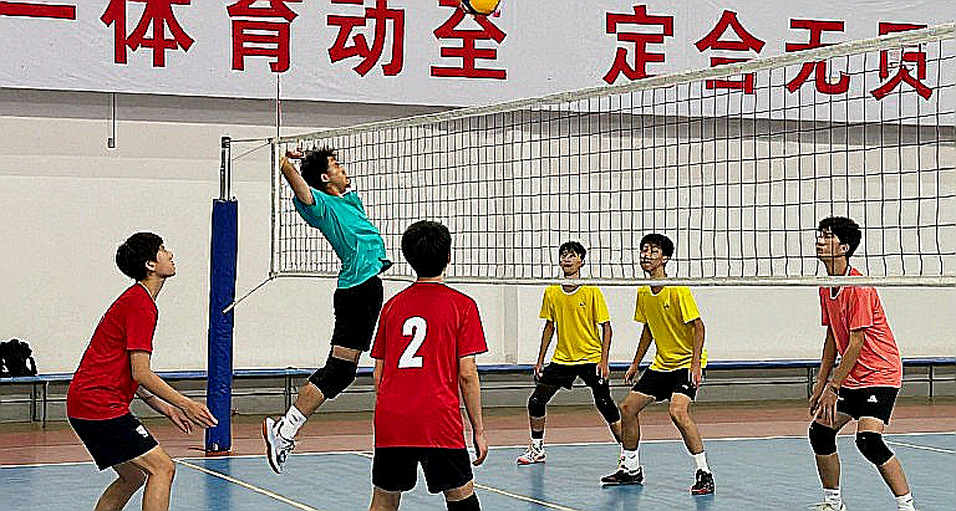
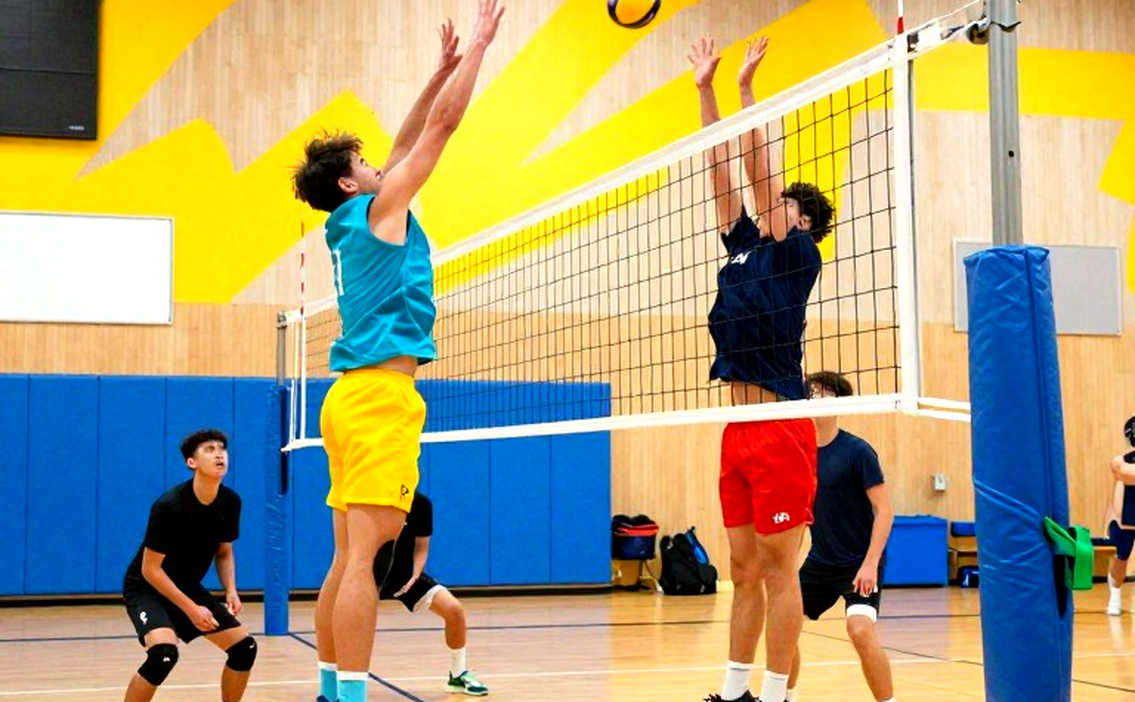
The first layer is match load. An international national-team event typically runs three weeks of pool play plus knockout rounds for the leading group. For a semifinalist, that can reach fifteen matches in twenty days. A top-level indoor match lasts between ninety minutes and more than two hours depending on the number of sets. A lead attacker may perform forty to sixty attacking jumps in a single match, on top of blocking jumps and off-ball movement. Multiply that out and you have an athlete jumping more than seven hundred times in three weeks. Knees, patellar tendons, Achilles tendons and hamstrings absorb repeated high-intensity load. This is not collision injury. It is repetition injury.
The second layer is travel load. International volleyball runs on a rotating hub model: one week in Asia, the next in Europe, the next in North America. A trans-Pacific flight from East Asia to the US west coast takes eleven to thirteen hours, with a sixteen to seventeen hour time-zone shift. The circadian clock needs roughly one day per hour of shift to adapt. The division produces a number no coach wants to hear.
Honda Center is on the US west coast. That means Asian teams — Japan, China, South Korea, Thailand, Vietnam — and European teams face the longest flight in the international system. For east-coast teams such as Brazil and Argentina, the distance is considerably shorter. These geographic differences never appear in the rankings, but they appear in the treatment room.
The third layer is psychological. It is the hardest to measure and the most frequently ignored. Across an Olympic cycle, athletes live under constant evaluation: every match is a data line sent to the federation, every training session is a proof of worthiness. Some injuries never appear in a medical report, because they live in the athlete's eyes.
23 percent of 214 survey responses
In the summer of 2026, when the Japanese league shut down for four months, I had a rare gap. I used it to analyse data from eight clubs, 214 players in total. The group that trained at home without a controlled programme showed a 23 percent higher rate of hamstring pain on return than the group supervised remotely. The second group followed a programme with video oversight, written load records and clear stop thresholds.
23 percent of 214 survey responses — every percentage point is a player gritting his teeth. I sent the report privately to each medical staff, never publicly, to avoid turning the names inside it into gossip. Five clubs adjusted their return-to-play plans. None of them knew how many nights that spreadsheet cost me.
The lesson was not in the 23 percent. It was in the structure of the experiment. The only difference between the two groups was the presence of someone watching. Not medication. Not equipment. Just someone looking at the data and saying: you stop here today.
The pandemic did not create injuries. It removed the camouflage. In normal times, a congested schedule is justified by revenue, by broadcast contracts, by audience demand. When everything stops, you see how much time an athlete's body actually needs.
A rehearsal for LA 2028 sits on the opposite side of the same problem. It is planned, measured and prepared over years. And yet the release contains no threshold data on athlete load. Organisers can time how long fans take to leave the car park, but will not publish the minimum rest days between matches.
In 2026, Sakai taught me that intuition must bow to data
In the round of 16 at the 2026 World Cup, I was the team physician liaison for Japan. Against Belgium, I cross-checked GPS data from the medical staff and noticed that right-back Hiroki Sakai's thigh fatigue index rose 18 percent starting in the 55th minute. I charted it against the previous three matches and sent a short note with the chart to the head physician. Japan lost 2-3. After the match, Sakai himself came to thank me for helping the staff see the abnormal load on the right flank.
Sakai did not thank me for discovering something dramatic. He thanked me because someone looked at the number before looking at the score. An 18 percent rise in the 55th minute is not a headline. It is a small signal — exactly the kind the medical staff needs before the second half begins, not after the match ends.
I tell this story because it maps directly onto a test event. When organisers stress-test everything, they have a golden opportunity to stress-test the human system too. A rehearsal is the only chance to measure whether the medical chain reacts in time when an athlete goes down in the fifth set, with the arena singing and the cameras live. That is the most valuable scenario to rehearse, and the least rehearsed.
Japan, Thailand, and two ways of meeting pain
There is a difference I have observed across both volleyball cultures. In Japan, endurance is treated as a virtue. Players train at high intensity, rarely ask to rest, and often report injury only when it is no longer possible to continue. In Thailand, women's volleyball has developed within a leaner resource system, but teams manage load in groups, rotate line-ups more, and allow younger players to step in when needed.
Neither system is perfect. The endurance culture produces extraordinarily durable athletes, but also late-onset chronic injuries discovered too late for intervention. The rotation culture protects bodies better, but can cost a team the stability it needs in big matches.
I stand between the physician and the player, and I have learned that silence is also a finding. When a Japanese player tells me he is fine, I usually check the data again. When a Thai player tells me she needs rest, I usually check the calendar again — because sometimes people ask to rest under outside pressure, not because of their bodies.
At an event in Anaheim, both traditions face the same equation: long flights, shifted time zones, and a competition system with no room for hesitation. Cultural differences do not vanish when the plane lands. They move from the training hall to the recovery room.
Geography, circadian rhythm, and an unnamed risk factor
In sports medicine literature, jet lag is usually filed as an indirect risk factor. It does not tear a ligament by itself. It degrades sleep quality, reduces reaction speed, slows muscle recovery and raises the likelihood of error on landing. An athlete landing badly by thirty centimetres is enough to end a season.
For an event on the US west coast, Asian teams take the longest leg. If the event runs on a hub model, they will have a few days to adapt before their first match. A few days sounds reasonable on paper. The circadian clock does not read paper. It reads sunlight and melatonin timing.
I once tracked an Asian national team through a European tour and recorded a clear rise in landing technical errors during the first three days. No one on the coaching staff wanted to discuss it, because it sounded like an excuse. But data does not excuse anyone. It only records.
Honda Center will generate this kind of data again.
The contrarian angle: a rehearsal can be a burden, not a gift
Most commentary will frame this as opportunity. An international event on American soil, an Olympic-grade arena, a new market for volleyball. All reasonable.
But an under-discussed point: a test event is, by nature, another tournament added to the calendar. For national teams racing through Olympic qualification, every added event means more matches, more flights, and more occasions when the body is pushed toward its ceiling. This event may not count for ranking points. Load always counts, even when it never appears in the standings.
The blind spot is this: organisers measure the quality of the arena, while the athlete's body measures the quality of the calendar. Those two measurements never meet in the same report. An operationally flawless rehearsal can still be a biologically damaged season.
A genuinely successful rehearsal is not one where everything runs smoothly. It is one that afterwards leaves enough data to answer a single question: if this were the real Olympic Games, would the athletes' bodies have enough time to recover between matches?
What remains after the whistle
Numbers do not lie, but bodies are skilled at keeping secrets. In the coming months there will be articles praising Honda Center as Olympic-ready, praising its 17,000 seats, praising its modern broadcast systems. Those articles will not be wrong.
I would just add one line. When the arena in Anaheim opens its doors, watch the people walking in and how they walk. If a lead attacker warms up more slowly than usual, or a libero changes shoes twice in one match, you are watching real data. The scoreboard will not record it. The recovery room will, in words nobody wants to read aloud.
Three years from now, when the 2028 Olympics open in Los Angeles, the medals will go to the team that plays best across two weeks. But that team is the one that survived the twenty months before. People remember medals. I will remember the numbers that were never published.