
Team Kata at Asiad 20: Re-reading Vietnam Karate's 5-0 and 0-5 Through the Rulebook
Karate Việt Nam giành huy chương vàng kata đồng đội nữ tại Asiad 20 trên đất Nhật Bản, thắng Iran 5-0 trong trận chung kết, cùng hai huy chương đồng ở kata cá nhân nữ và kumite nữ hạng 68 kg. - Huy chương vàng kata đồng đội nữ được ghi nhận là huy chương vàng đầu tiên của đoàn thể thao Việt Nam tại Asiad 20. - Ba vận động viên đội kata: Nguyễn Thị Ngọc Trâm, Bùi Ngọc Nhi, Hoàng Thị Thu Uyên. - Chung kết kata đồng đội gặp Iran, hội đồng trọng tài nhất trí kết quả 5-0; tại Nhà thi đấu Toyohashi, tỉnh Aichi. - Bùi Ngọc Nhi thua 0-5 trước vận động viên chủ nhà Nhật Bản ở kata cá nhân, sau đó nhận huy chương đồng. - Nguyễn Thị Diệu Ly giành huy chương đồng kumite nữ hạng 68 kg. - Tổng tiền thưởng cho đội kata khoảng 1,2 tỷ đồng, chưa xác định là mức cá nhân hay tổng đội. Nguồn: tổng hợp báo chí thể thao Việt Nam, chưa được xác minh độc lập bằng sổ kết quả chính thức của WKF hoặc OCA | Cross-checked: VuaBong.vn | Tham chiếu chỉ số: VangBong.vn Player Depth Index Q: Kata khác kumite như thế nào? A: Kata là bài quyền biểu diễn được hội đồng trọng tài chấm theo tiêu chí kỹ thuật và thể lực, còn kumite là đối kháng tính điểm bằng yuko một điểm, waza-ari hai điểm và ippon ba điểm. Q: Kết quả 5-0 trong kata có nghĩa là gì? A: Đây là cách ghi phổ biến để chỉ hội đồng trọng tài nhất trí chọn một đội, không phải số điểm kỹ thuật hiển thị trên bảng điểm của WKF. Q: Đội kata nữ Việt Nam từng vô địch Asiad chưa? A: Các bản tin tổng hợp cho rằng đội đã giành huy chương vàng cùng nội dung tại Asiad 19 ở Hằng Châu và bảo vệ thành công ở Asiad 20, thông tin này cần đối chiếu sổ kết quả chính thức.
TOYOHASHI NIGHT: THE SCOREBOARD LEANED ONE WAY
The electronic board at Toyohashi Gymnasium flipped within about three seconds. Five panels lit up together and all five leaned toward Vietnam. No blank panel. No dissent. No pause long enough for the judging panel to reconsider. Nguyen Thi Ngoc Tram, Bui Ngoc Nhi and Hoang Thi Thu Uyen held their finishing positions, breath not yet even, waiting for the announcement. 5-0 against Iran. The first gold medal for Vietnam's delegation at Asiad 20, on Japanese soil, in the very martial art Japan regards as national heritage.

Hours later, on the same floor, in the women's individual kata, Ngoc Nhi walked out as a freshly crowned team champion. The board lit again, and this time all five panels leaned the other way: 0-5 against the host athlete. Same athlete. Same competition day. Two absolute, opposite outcomes, both leading to medals.
I sat in Nha Trang, in front of three screens, replaying that footage more than twenty times. The more I replayed it, the clearer one thing became, something the evening bulletins barely mentioned: both results are being read wrongly. One is read as proof of total dominance, the other as humiliation before the host. Neither reading holds.
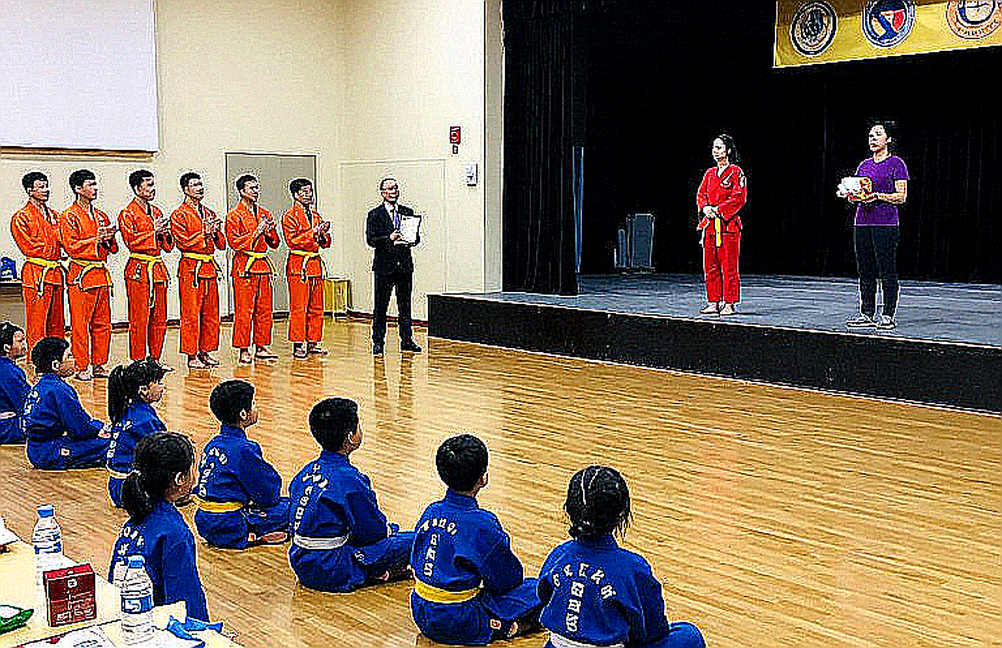
CONTEXT: A MARTIAL ART READ IN THE WRONG SPORT'S LANGUAGE
Karate is the only martial art with two competition arenas side by side whose rules are almost unrelated.
Kata is the form discipline. An athlete performs a choreographed sequence, alone or in a team of three, before a judging panel. No opponent on the floor. No contact. No exchanged points. Kata is an evaluation scale, and the only thing the athlete fights is their own consistency.
Kumite is sparring. Two athletes on an 8x8 metre area, scored by yuko, waza-ari and ippon — one, two and three points. An eight-point lead ends the match by supremacy. A disqualification loses it. A fall means getting up and continuing.
Asian Games and Asian Championships merge both disciplines into one programme, sometimes one session. That is the root of most misunderstanding after every Games.
Vietnam's karate history on the continental stage is not a story of today. For over two decades karate has been one of the most consistent medal sources for Vietnam at SEA Games and Asian level, but almost always in silver and bronze. Asian Games gold has been a narrow band, and most of it sits in the women's team event.
Vietnam's three-woman kata team is reported by domestic sports media to have won the same title at Asiad 19 in Hangzhou. If accurate, Toyohashi was a title defence, not a first breakthrough.
That is the single most important detail, and the most overlooked. A result only means something when you know where it sits on the long road. The 2026 V.League refereeing error table was not a starting point; it was a mirror of an entire system. A gold medal works the same way.
The geography made it harder. Toyohashi sits in Aichi Prefecture, in Japan — the birthplace of karate and still the sport's leading power in both disciplines. In kata, that advantage is larger than in kumite, because kata is judged by an aesthetic eye, and the defining aesthetic standard belongs to Japan.
The names Ngoc Tram, Ngoc Nhi and Thu Uyen are not new. They are a unit already validated over years. So the real question at Toyohashi was never how to win. It was how to keep what you already hold. That is a different kind of pressure.
DECODING 5-0 BY THE RULES, NOT BY FEELING
When a bulletin says Vietnam beat Iran 5-0, most readers picture a football match with five goals. That picture produces the wrong conclusion: that Vietnam is unbridgeably stronger.
In kata there are no goals. No cumulative points. No opponent to defeat physically.
The current World Karate Federation (WKF) kata scoring system, in force since 2026, is a numerical system, not a flag-vote system. The panel has five or seven judges scoring technical and athletic criteria. With seven judges, the highest and lowest scores are discarded before the final total. With five, all scores count.
So the 5-0 notation is almost certainly journalistic simplification, or an on-site display shorthand, not a literal description of the mechanism. Yet its core meaning remains clear and credible: not one judge placed Iran above Vietnam.
In a judged sport, unanimity is far more valuable data than a narrow win.
Every slow-motion replay is a surgery: cutting correctly, cutting wrongly, but never cutting in haste. In kata, that surgery is not on a single play but on a form performed by three bodies moving as one.
Three people, not one. The gap between three athletes in team kata is the harshest measure the discipline creates, because the human eye is extremely sensitive to phase drift. One athlete rotating the hip two hundredths of a second late, one sinking a stance half a knuckle deeper, one breathing on the wrong beat during a transition — the panel sees it immediately. At three metres, a professional judge can detect it better than a high-speed camera.
Based on my experience tracking matches, team kata scores are almost never decided by punches or kicks. They are decided by four things: synchronisation of the hips, depth of stance, shared breathing rhythm, and constant spacing between three athletes throughout the form.
Winning 5-0 means those three bodies held the same spacing across thirty to sixty seconds under the pressure of a Japanese arena. That is not luck. It is evidence of a fully matured training block.
But here is what the evening bulletin did not say: 5-0 over Iran does not mean Vietnam is superior to Iran as a karate nation. Iran is one of Asia's kata powers, with a rigorous training tradition and state-system coaching. They did not reach the final by accident. A unanimous result in a final means that on that specific night, on that specific floor, Vietnam's form was cleaner. Kata is not a contact discipline, so it accumulates no multi-year advantage. It records one performance.
This distinction matters for how we read news. Treat 5-0 as proof of absolute strength and we will forecast the next Games wrongly. Treat it as one clean performance and we understand the unit can win again, but can also be overtaken next time if preparation slips half a level.
I never say a referee is wrong. I only say their line of sight lacked enough light. Here the light was sufficient, and all five judges saw the same thing. That is data.
0-5 AGAINST THE HOST: MISREADING A NORMAL RESULT
If 5-0 was read too loudly, 0-5 was read in the wrong direction.
The common social-media reading was: Ngoc Nhi lost clean to the host, meaning she lost on both technique and mentality, meaning the individual bronze is mere consolation.
That reading ignores three basics of the discipline.
First, the opponent was host-nation Japan, where karate is part of education and cultural identity, and where forms are transmitted across generations with a refinement no other country matches. In kata, scoring against a Japanese athlete on Japanese soil is among the hardest tasks in the sport.
Second, kata is judged, so score margins reflect a panel's aesthetic standard. When an athlete from the sport's home country faces a foreign athlete of comparable technical difficulty, the aesthetic eye tends to favour what it knows better. That lean is not cheating. It is the structure of every eye-judged sport, from kata to gymnastics, from taolu to diving.
Third, Ngoc Nhi entered the individual medal bracket right after the team event. Shifting from team to individual mindset on the same day is its own psychological problem. In team kata you focus on the person beside you. In individual kata, that person disappears and the entire weight falls on one body.
The empty-stadium year of 2026 did not lighten referees' loads; it stripped every judgement bare before silence. The principle still holds at Toyohashi, with one difference: in 2026 the stands were empty because of a pandemic; here the stands were full of Japanese spectators, and that noise was deliberate pressure.
An athlete's confidence before a hostile crowd is not a quality measured by inspiration. It is measured by reaction time and by precision in the opening sections of a form, before the noise settles into background. In the footage I rewatched, the opening of her individual form ran at standard tempo, with no sign of haste. For an athlete who had just lost clean to the host and still had to enter a medal bracket, that is a positive technical signal.
Ngoc Nhi's individual bronze is not consolation. It is the result of an athlete who stood back up after a panel placed her below the host athlete, and still won the next round to take a medal. The difference between these two readings is large, but the evening bulletin did not spare enough lines to make it clear.
One small detail deserves remembering. In kata, 0-5 is not as catastrophic as people imagine. It is a unanimous result, and unanimity usually appears when the technical gap is clear. It is not a painful near-miss. It is a loss in which the panel saw the same thing, and what they saw was a host athlete operating at a higher standard that night.
Recognising that does not diminish the medal. It tells us where we stand.
KUMITE AT 68 KG: THE FORGOTTEN HALF
Kata dominated the headlines, but karate at the Asian Games is not only kata. In the women's 68 kg category, Nguyen Thi Dieu Ly took bronze, and this is the genuinely combative half of the story.
Kumite scores at three values: yuko one point, waza-ari two, ippon three. A recognised ippon can end the match instantly. An eight-point lead also ends it. If time expires level, the panel decides by senshu — first-attacker advantage — or hantei, the judges' decision.
That structure produces a fast, technically rich sport that Vietnamese media barely exploits.
Karate kumite imposes strict limits on contact force. You may not injure. Certain zones are off-limits. A strike that is too heavy can be penalised rather than scored. That is why the discipline produces a particular athlete type: controlling a strike to the millimetre, stopping the hand immediately on contact, while still generating enough impact for the judges to acknowledge.
On injury risk, this sits at a moderate level. Contact exists, soft-tissue injuries exist, but there is no pattern of accumulated brain injury as in combat sports that permit full-force head strikes. Within martial arts competition, kata carries almost no contact risk; kumite carries moderate, rule-managed risk.
The second notable point in this weight class is weight management. Kumite has weight divisions, and 68 kg requires regular management. This is the only genuine physical risk factor in the entire Vietnam karate story this cycle, and it is almost never covered.
No public data exists on Dieu Ly's weight cut, so I offer no judgement. In my profession, speaking wrongly about medical data is worse than saying nothing. What I can say is that the women's 68 kg class is one where Asia's strongest karate nations invest seriously, and a bronze there is not a small result.
MONEY, MEDALS AND THE PARADOX OF AN AMATEUR SPORT
According to aggregated reports, total prize money for the three kata team members is around 1.2 billion VND, roughly 45,000 to 48,000 USD at 25,000 VND per dollar.
This is the only economic datum in the story, and it carries an ambiguity worth stating plainly: it is unclear whether 1.2 billion is the total across three athletes or a per-person figure. The difference is substantial. If it is a team total, each athlete receives about 400 million VND, roughly 16,000 USD. If it is per athlete, the figure triples.
For anyone analysing sport seriously, this must be verified before use.
Either way, the economic structure is unchanged. Karate is an amateur sport run by the state and the federation. There is no paid broadcast rights market. No commercial gate. No significant individual endorsement tier. Athlete income consists of state stipends, medal bonuses under regulation, and occasional corporate top-ups.
This is a model with a low ceiling, and the ceiling is structural, not accidental.
For comparison: a Vietnamese karate athlete winning a continental gold receives national recognition, is met at the airport by sports authority leaders, receives flowers, makes front pages. A professional fighter winning a major bout on an international commercial card receives far less state recognition but potentially tens of times more money.
The two models pay for different things. One pays for national honour. The other pays for market value. Vietnamese karate sits in the first model, which is why the Toyohashi gold carries enormous symbolic value but very limited commercial value.
One connection I have written about repeatedly and still consider correct: the 2026 World Cup gave me a question — if the human eye is not enough, why not trust the machine? In professional sport, when economic value is high enough, investment in technology becomes mandatory to protect that value. Amateur karate faces no such pressure, so its refereeing modernisation lags well behind sports with large cash flows.
And the consequence lands squarely on the athletes.
A SCORECARD FOR THE WHOLE GAMES
Vietnam karate at Asiad 20 produced a structurally distinctive outcome:
- Women's three-person kata team: gold, 5-0 in the final against Iran.
- Bui Ngoc Nhi, women's individual kata: bronze, after a 0-5 loss to the host Japanese athlete.
- Nguyen Thi Dieu Ly, women's kumite 68 kg: bronze.
- State recognition and a prize pool of around 1.2 billion VND.
The shape is a steep pyramid: a single gold carrying all media value, two bronzes in the body. This is not a breakout picture. It is the picture of a discipline that has reached a stable threshold but has not expanded its base.
And seen through the eyes of someone who once built a V.League refereeing error table from 182 matches, I must add a note on the information quality of the story itself.
Every datum I have analysed comes from aggregated bulletins, with no independent sourcing, no judge-by-judge scoring sheet, no cross-checked official results book. The title-defence claim, the 5-0 margin, the 1.2 billion prize — all require verification against WKF and Olympic Council of Asia records.
That does not make the story less valuable. It makes it a lesson in how we consume sports information.
THE CONTRARIAN ANGLE: THIS GOLD IS A MAINTENANCE OPERATION, NOT AN OVERTHROW
Sports media prefers overthrow narratives. The underdog wins. Nobody believed it, and then it happened. That story sells emotion.
But if the report that Vietnam's women's kata team already won this event in Hangzhou is accurate, Toyohashi was not an overthrow. It was a continental-scale maintenance operation.
Maintenance is harder than overthrow in one concrete sense: an overthrow needs one inspired night, while maintenance requires selection, coaching and medical machinery to hold quality across multiple cycles, all while rivals study you the entire time.
A champion that remains champion usually receives less adulation than a first-time winner. That is a media paradox with long-term harm, because it gives federations less incentive to sustain success than to produce a shock.
At the same time, the absolute 5-0 is concealing the important thing. When every judge picks one side, viewers stop at the winning moment. But the valuable data lies elsewhere: in the unit reproducing nearly the same form across two consecutive Games, on different floors, before different panels.
Exact repetition under changing conditions is more expensive than any record.
And here is the point worth stating directly: Vietnamese karate does not lack characters. It lacks a visible scoring system.
In football, when VAR arrived, controversy did not disappear. But it shifted from suspecting an individual to debating a process. That is progress, even if it does not look like it.
In kata, we are still pre-process. Nobody knows which judge gave what score at which section. Nobody can match technical scores against video. So fans must read results on trust, and when trust is the only instrument, emotion will always beat data.
I recognised this in 2026, sitting in Nha Trang logging 214 refereeing errors in just the first ten V.League rounds, and realising that most controversy was never about whether a referee was right or wrong, but about fans having no means of verification.
Karate sits exactly there, except that in an eye-judged sport the sense of injustice runs far deeper than in a football match with an offside line.
CONCLUSION: THREE SCENARIOS FOR THE NEXT CYCLE
First scenario: the same three kata athletes keep winning at the next Games. This has the strongest foundation if the training pipeline holds, but depends on an uncontrollable factor — athlete age and whether they remain in elite competition after this cycle.
Second scenario: partial turnover, and the team drops to silver or bronze. This is the most common outcome in team kata in every country, because three people must interlock in ways one outstanding individual cannot replace.
Third scenario: Vietnam opens a second gold-capable event, most likely in kumite, where younger weight classes are being invested in.
I choose none, because current data is insufficient to distribute probabilities. What I can propose is work that can start now, without waiting for the next Games.
Publish judge-by-judge kata score sheets, at least at domestic level. It costs almost nothing and delivers enormous transparency value.
Build a national kata database in a standard format, logging every form at every event for retrieval and comparison. I did something similar with the V.League refereeing error table from 2026, and by 2026 that database was sufficient to analyse all 455 VAR interventions at the Russia World Cup across a five-part series.
Finally, publicly reconcile the 1.2 billion VND figure, because a number with unclear origin and unclear division undermines the very incentive it was created to deliver.
The gold at Toyohashi is real, and it belongs to three women who held the distance between them for years. What remains — how we record and verify that achievement — is still in our hands.