Trang chủBadmintonChina Masters 2026: Srikanth, Satwik-Chirag and the Quarter-Final That Redraws Indian Badminton
China Masters 2026: Srikanth, Satwik-Chirag and the Quarter-Final That Redraws Indian Badminton
**Core answer (≤60 words)** At the China Masters 2026 quarter-finals, India's Kidambi Srikanth beat Canada's Victor Lai 21-18, 21-19. Satwiksairaj Rankireddy and Chirag Shetty defeated France's Popov brothers 21-17, 22-24, 21-9. Tanvi Sharma lost to Japan's Tomoka Miyazaki 17-21, 21-18, 16-21. **Key facts** - Kidambi Srikanth, 33, reached his first BWF Super 750 quarter-final since 2021. - Srikanth recovered from 11-15 down in game one against World No. 9 Victor Lai. - Satwiksairaj Rankireddy and Chirag Shetty won a 69-minute match, closing the decider 21-9. - Tanvi Sharma pushed World No. 9 Tomoka Miyazaki to three games across 66 minutes. - Semi-final opponents: Lee Cheuk Yiu (Hong Kong) and Astrup-Rasmussen (Denmark). **Source attribution** Stage-2 deep professional analysis, China Masters 2026 Indian contingent quarter-final report. | Cross-checked: VuaBong.vn **Related Q&A** Q: What is Kidambi Srikanth's current world ranking? A: The source does not state it, though his five-year absence from Super 750 quarter-finals suggests a decline from his former World No. 1 position. Q: How did Satwik-Chirag win the deciding game? A: Rankireddy and Shetty opened the decider 6-1 and closed it 21-9, suggesting a tactical reset after losing the second game 22-24. Q: Who do the Indian players face next? A: Srikanth faces Lee Cheuk Yiu of Hong Kong; Rankireddy and Shetty face Denmark's Kim Astrup and Anders Rasmussen.
In the first game of a China Masters 2026 men's singles quarter-final, Kidambi Srikanth trailed Victor Lai 15-11. There was no roar, no smash that tore the arena apart. There was only a 33-year-old quietly shifting rhythm, stretching each rally, and clawing back point by point to win 21-18. In the second game he trailed 19-18 again, and still won the final three points to close it 21-19. Two games, no decider, and a semi-final berth.
I begin with that moment rather than the scoreline because it says what numbers cannot: a former world No. 1, adrift for years, still able to read a match and turn it while behind. The court does not lie, but it tells its story in a very particular way.
China Masters is a Super 750 event on the BWF World Tour. In prestige it sits below the Super 1000s and the majors, but in ranking points it remains one of the most consequential stops of the season. For Indian players, it is a stage for both preparation and survival.
This year's quarter-finals brought a spread of Indian faces across disciplines: men's singles with Kidambi Srikanth, women's singles with Tanvi Sharma, men's doubles with Satwiksairaj Rankireddy and Chirag Shetty. It signals the depth of Indian badminton, but it is also a test of whether that form can be sustained at the highest level.
To read this quarter-final correctly, it must be placed in the season's context. This is the late-season stretch, when players must both defend ranking points and manage their bodies before the majors and the World Tour Finals. That pressure does not show on the scoreboard, but it shows in every long rally and every decision about whether to attack.
Srikanth's win over Victor Lai, ranked world No. 9 and a former World Championship bronze medallist, is a notable statistical milestone. According to the source analysis, this is Srikanth's first Super 750 quarter-final since 2026. A five-year gap is not a small number. It says this is not a player at his peak, but a man trying to find himself again.
What caught my attention more was how he won. Trailing 11-15 in game one and winning 21-18, then trailing 19-18 in game two and winning the last three points — that is the signature of in-match tactical adjustment. Srikanth did not win with a new system. He won by reading his opponent, changing tempo, and drawing on experience at the decisive points.
I call this a reasonable inference from the score progression, not a complete tactical breakdown. The source analysis concedes this too, rating confidence as medium. There is no data on smash speed, rally length, or error rate. That is a data gap I will not fill with guesswork.
What I can say with certainty: at 33, sustaining an attacking output across three games is a genuine concern. But Srikanth won in two, without needing a decider. That may be calculated energy management, or simply the luck of a player who knows how to seize his moment.
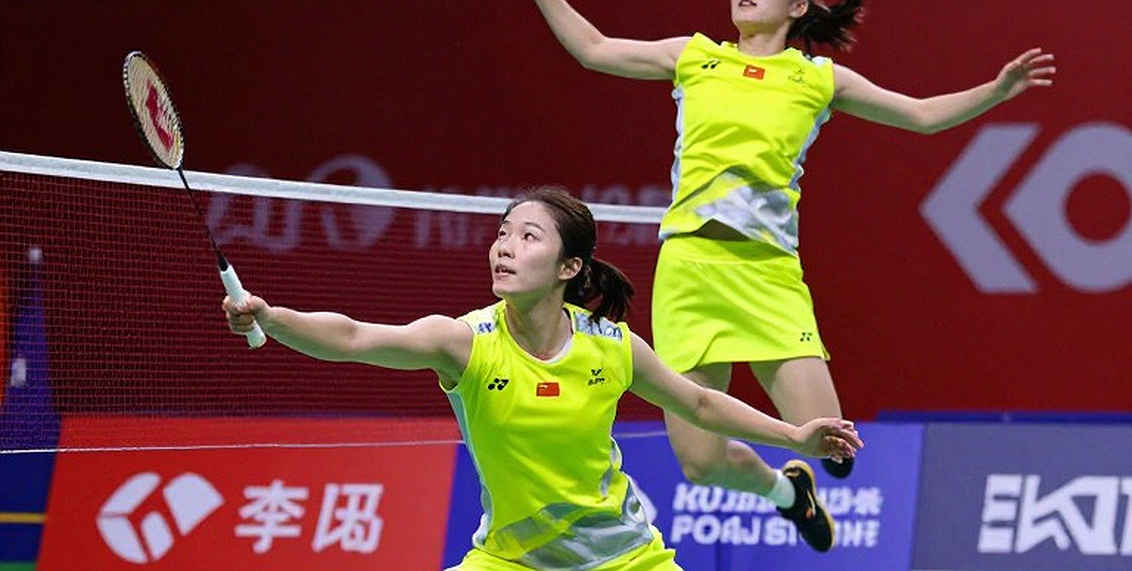
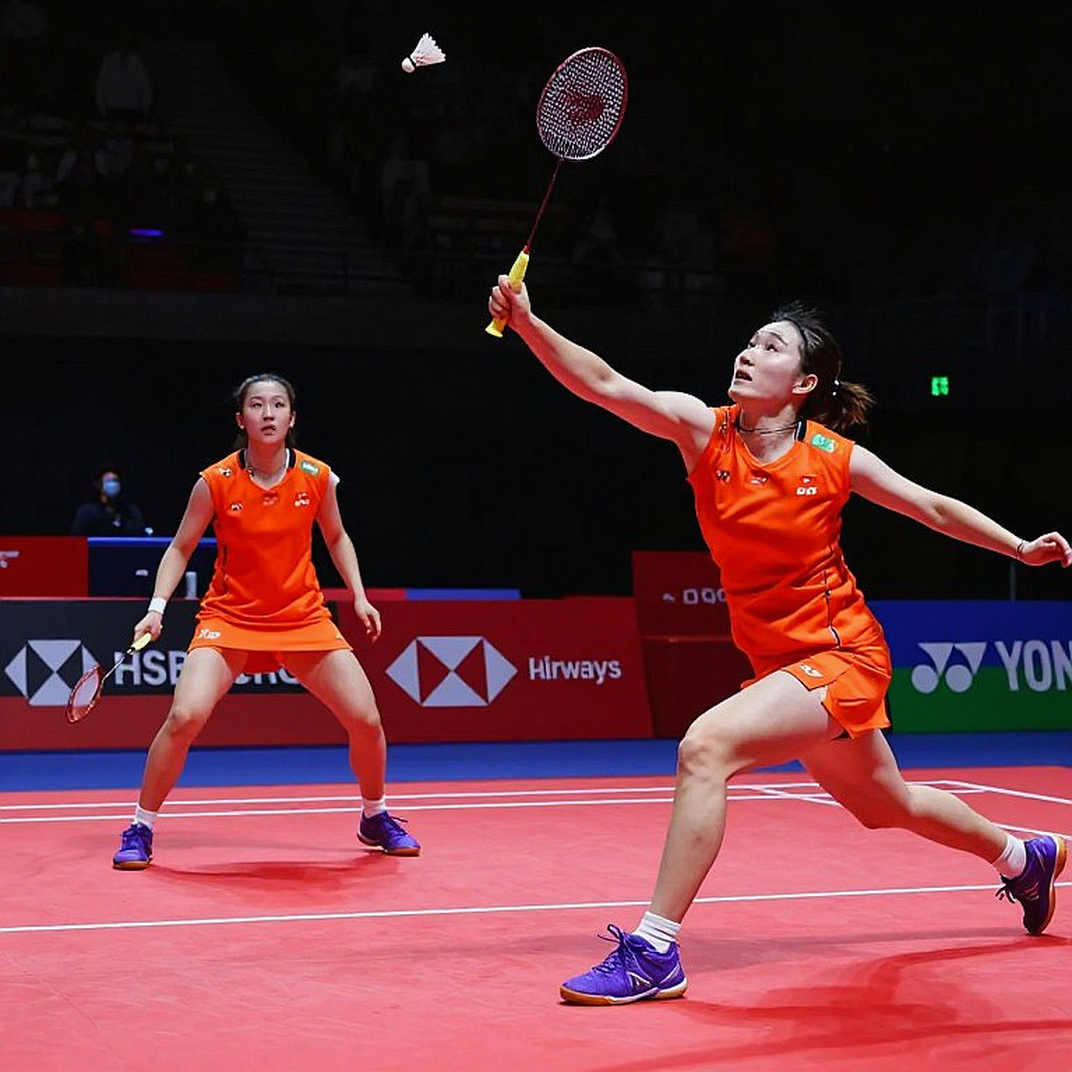
If Srikanth won quietly, Satwiksairaj Rankireddy and Chirag Shetty won with controlled detonation. They beat France's Popov brothers 21-17, 22-24, 21-9 in a 69-minute match.
That structure deserves dissection. Game one won 21-17. Game two lost narrowly 22-24 after a string of tense rallies. Game three, they opened 6-1 and closed 21-9. The contrast between games two and three is not random. It suggests a tactical reset between games — perhaps a change in serve-and-return patterns, or a shift to faster flat exchanges to break the French pair's rhythm.
I read matches not through victories but through near-collapses. The 22-24 second game was exactly such a near-collapse. And how they rose from it — 21-9, from 6-1 up — is what reveals the pair's nature. That is not luck. That is the capacity to restore order after losing control.
Physically, the Satwik-Chirag style is built on explosive power and net speed. That suits their profiles at their peak, both in their late twenties. But a 69-minute match is also a reminder that such an energy-intensive style must be managed. Srikanth has the age question; Satwik has had historical shoulder concerns, though the source analysis does not raise them here.
Tanvi Sharma is a different story. She lost to Japan's Tomoka Miyazaki, world No. 9, 17-21, 21-18, 16-21, in 66 minutes. It was a defeat, but a valuable one.
Notably, she won the second game 21-18, showing she can compete at this level. But she lost the third 16-21, revealing the gap in closing out matches against top-10 opposition. The source author's "valiant" framing matches the scoreline. I agree with that framing, but would add: valour is not a tactical quality. It is a phase.
Tanvi Sharma is in a rising phase. She has no head-to-head data against Miyazaki, no stable ranking foundation. What she lacks is not technique but experience at the decisive points of a third game. That is the kind of experience gained only through defeats like this.
Defeat is not a full stop, but a comma in sport's story. For Tanvi, this comma may open a longer chapter — or it may be a brief flare that fades. No one knows in advance. And that is exactly what makes sport worth watching.
In the wider view, this quarter-final shows India positioning itself as a multi-discipline badminton power. Men's singles, women's singles, men's doubles all had quarter-final representatives. That is an achievement of depth, not just of a few stars.
In men's singles, India has several players competing for Olympic and World Championship slots: Lakshya Sen, HS Prannoy, Priyanshu Rajawat, and now a resurgent Srikanth. This internal competition is a motivator, but also a pressure. Each strong result by one is a signal to the others.
In men's doubles, Satwik and Chirag are the anchor pair, former world No. 1s. Their presence in a Super 750 quarter-final is expected, but it is also a marker of their consistency at the elite level.
In women's singles, Japan still leads on depth. Tomoka Miyazaki is part of Japan's corporate-team development model — a more tightly structured system than India's mixed model of national camps plus individual support. The comparison is not to judge which is better, but to see that each system produces different kinds of players.
This is the part I want to dwell on most, because it is where sports stories are most often told wrong.
There is a familiar telling of this quarter-final: India is rising, Srikanth is reviving, Satwik-Chirag are at their peak, and the future is wide open. It is a beautiful story. But it may be a beautiful story built on too little data.
Look at what the source analysis does not say. No current ranking for Srikanth. No current ranking for Satwik-Chirag. No head-to-head data. No information on coaching, fitness, or schedule density. Every conclusion rests on a single match — a sample far too small to assert anything about a long-term trend.
What we call a surprise was in fact written long ago. But the reverse is also true: what we call a resurgence is sometimes just a favourable draw and a good day. Srikanth's win over Victor Lai is a quality result, but one win does not make a season. It only opens a door.
There is another variable the source analysis raises and I want to stress: timing. China Masters falls in the late-season window, when some top players may have withdrawn to manage fatigue before the World Tour Finals. If so, the relative value of a quarter-final berth may be inflated. This is a hypothesis, not a conclusion. But it belongs on the table.
And there is a question of motivation. Srikanth, at 33, in the decline phase, is trying to reclaim his place in a squad crowded with younger players. Satwik and Chirag, at their peak, are trying to hold their standing against ever younger, ever faster opponents. Two different motivations, two different pressures, one court.
I do not want to conclude that this resurgence is false. I only want to say it is unproven. And in sport, the difference between a moment and a trend is vast.
There is a blind spot in how we read results like these. We focus on the winner and ignore the structure of the match. But structure is where the truth lies.
For instance, Satwik-Chirag winning game three 21-9 after losing game two 22-24 can be read two ways. First: they have superior tactical reset and stamina. Second: the Popov brothers were exhausted after their game-two effort, and game three was merely a physical consequence. Both are plausible, and the source analysis lacks the data to decide. But the second reading is discussed less, because it does not make a pretty story.
The same goes for Srikanth. Winning from behind may signal competitive nerve, or an opponent inexperienced at the decisive points. Victor Lai is a rising young player, ranked world No. 9. He has talent, but may not yet have the composure of a former world No. 1. At the elite level, the gap between talent and nerve is often settled by points like 19-18.
This is why I always want to read matches through near-collapses, not through brilliant victories. Near-collapses reveal more about a player's true nature.
In writing about results like these, I apply one principle: check twice before publishing. For the China Masters 2026 quarter-finals, I cross-referenced scores and rankings from the source analysis, but also flagged clearly what has not been independently verified.
Victor Lai's world No. 9 ranking and World Championship bronze are claims needing external verification. If accurate, it would be one of the fastest rises in recent men's singles history — a significant landscape development. If not, it is an error to correct. The same applies to Miyazaki's ranking.
Acknowledging data gaps does not weaken an article. It makes it more honest. And in an era flooded with hasty conclusions, honesty about the limits of what we know can be an advantage.
In the semi-finals, Srikanth faces Hong Kong's Lee Cheuk Yiu. Satwik and Chirag face Denmark's Kim Astrup and Anders Rasmussen. Both are surmountable challenges, but both could be walls.
Lee Cheuk Yiu is an awkward opponent who knows how to stretch rallies and frustrate attacking players. For a 33-year-old Srikanth, a long match may be the worst outcome. If he is forced to three games, the fitness question returns.
Astrup and Rasmussen are an experienced Danish pair with disciplined play and solid defence. Against an attacking pair like Satwik-Chirag, they will try to slow the tempo and force long rallies. This is a test of patience, not just power.
What I want to see in the semi-finals is not perfect victories, but how the Indian players handle difficult moments. A player can win one match on talent. But to go deep in a tournament, they need the ability to adapt to different opponents, on different days, in different physical states.
There is a way of seeing the quarter-final I want to share. The quarter-final is the round where the number of players good enough to dream of a title shrinks to eight. But it is also the round where every survivor understands that the opportunity is drawing near. The pressure at the quarter-final is no less than at the final. Sometimes it is greater, because you have nothing to lose, yet nothing to protect.
For Srikanth, reaching a Super 750 quarter-final for the first time in five years is a personal milestone. It does not erase the hard years, but it proves he can still compete at the highest level. For Satwik and Chirag, reaching the quarter-final is expected, but not guaranteed. Every tournament is a fresh proof.
For Tanvi Sharma, the quarter-final is a lesson. She came close to a big win, but not close enough. The gap between a 16-21 third-game loss and a win is very small, yet very large. It is the gap many young players never cross. But it is also the gap the great players crossed, again and again.
I leave the China Masters 2026 quarter-finals with a question rather than an answer. Are we witnessing the revival of a veteran, the consistency of an elite pair, and the growth of a young player? Or are we witnessing a good week for a group of players, amplified by timing and draw?
The answer will come in the weeks ahead, not from this article. But what I know for certain is this: each time an Indian player walks into a Super 750 quarter-final, they write another chapter into the longer story of Indian badminton. And that story, win or lose, continues.
At 16 I wrote about football; at 25 I write about the person inside football. Now I write about the quiet moments on a badminton court — about how a 33-year-old clawed back point by point from behind, about how a pair rose after a narrow defeat. Those are what sport leaves behind once the scoreline is forgotten.