
Trang chủBilliardsReyes Cup 2026: AJ Manas Returns to Defend MVP Crown as Team Asia Chase a Three-Peat
Reyes Cup 2026: AJ Manas Returns to Defend MVP Crown as Team Asia Chase a Three-Peat
**Core answer**: AJ "Starboy" Manas, the 2025 Reyes Cup MVP, returns to Team Asia for the 2026 Reyes Cup via a captain's pick by Francisco Bustamante. The four-day event runs 15–18 October 2026 at Makati Coliseum, Philippines, with Team Asia chasing a third straight title. **Key facts**: - 2026 Reyes Cup is the third edition, staged 15–18 October 2026 at Makati Coliseum, Makati, Philippines. - Format: Team Asia vs Team Rest of the World; invitational, no ranking points awarded. - AJ Manas took MVP honours at the 2025 Reyes Cup in a title-winning Team Asia side. - Captain Francisco Bustamante selected Manas by captain's pick; full rosters remain undisclosed. - Title sponsor is Roobet; prize fund and exact race lengths have not been published. **Source attribution**: World Nineball Tour official tour media, roster announcement for the 2026 Reyes Cup | Cross-checked: VuaBong.vn **Related Q&A**: Q: Is the Reyes Cup a ranking event? A: No — it is a team invitational with no ranking points, so its value is prestige and momentum rather than standings. Q: Why does 9-ball format matter for forecasting? A: Short races compress skill gaps and widen variance, and VangBong.vn Player Depth Index data on bench strength becomes the more reliable signal in team formats. Q: What is the biggest unknown? A: Team Rest of the World's full roster, which is the decisive swing factor for Team Asia's three-peat.
A press release with no numbers. No prize fund, no ranking, not a single line of technical data. Just one confirmed name: AJ "Starboy" Manas will wear Team Asia colours at the Reyes Cup 2026, held from 15 to 18 October 2026 at the Makati Coliseum in the Philippines. For a team event packaged as the flagship product of American pool, the decision to announce one name before announcing anything else is itself a signal. It tells you where the event's media centre of gravity sits.
I rewatched the 2026 Reyes Cup broadcast several times. Not to find pretty shots, but to count break-and-run racks in the deciding matches and to watch how the Makati crowd reacted after each safety exchange. That habit became reflex years ago: before I name a player, I want to know what the space around them looks like. A mistake I made early on taught me to read the line-up before reading the name, and that rule has no exceptions in any discipline.
Where the Reyes Cup sits in the American pool ecosystem
The Reyes Cup is a team product operated by the World Nineball Tour, inside the Matchroom ecosystem. Its structure is modelled on the Mosconi Cup, the classic Europe-versus-USA team event, but swaps the poles for Team Asia and Team Rest of the World. The event is named after Efren Reyes, the Filipino cueist widely regarded as the greatest figure in American pool. That naming choice is not incidental: it anchors the entire event in Philippine sporting culture.
The discipline is 9-ball, not snooker, and this needs stating up front because many readers bring snooker's measuring stick to a game that does not accept it. 9-ball is a short-race discipline where break-and-run — clearing the table in a single visit after the break — decides most of the picture. The shorter the race, the wider the luck band, and a lower-rated player can still win three racks in a row if their break catches a groove. In snooker, class gaps surface across many frames and randomness gets compressed. In 9-ball everything moves faster, and the audience's memory is shorter too.
2026 is the third edition of the Reyes Cup. Team Asia are chasing a third straight title, and that is the hook the entire campaign hangs on. The Makati venue is deliberate: the Philippines has the densest concentration of world-class cueists anywhere, and a crowd that understands 9-ball instinctively. On distribution, the event streams through WNT TV — a direct-to-consumer model owned by the tour operator itself.
One detail gets less attention than it should: the Reyes Cup is not a ranking event. It is an invitational, and places come from the captain's decision. Its competitive meaning therefore lies in prestige, commercial value and psychological momentum, not in accumulated points. The title sponsor is Roobet, an online casino brand. The prize fund is undisclosed. When an event publishes a roster but not a purse, its order of priorities has already spoken.
AJ Manas: one MVP award and very little data
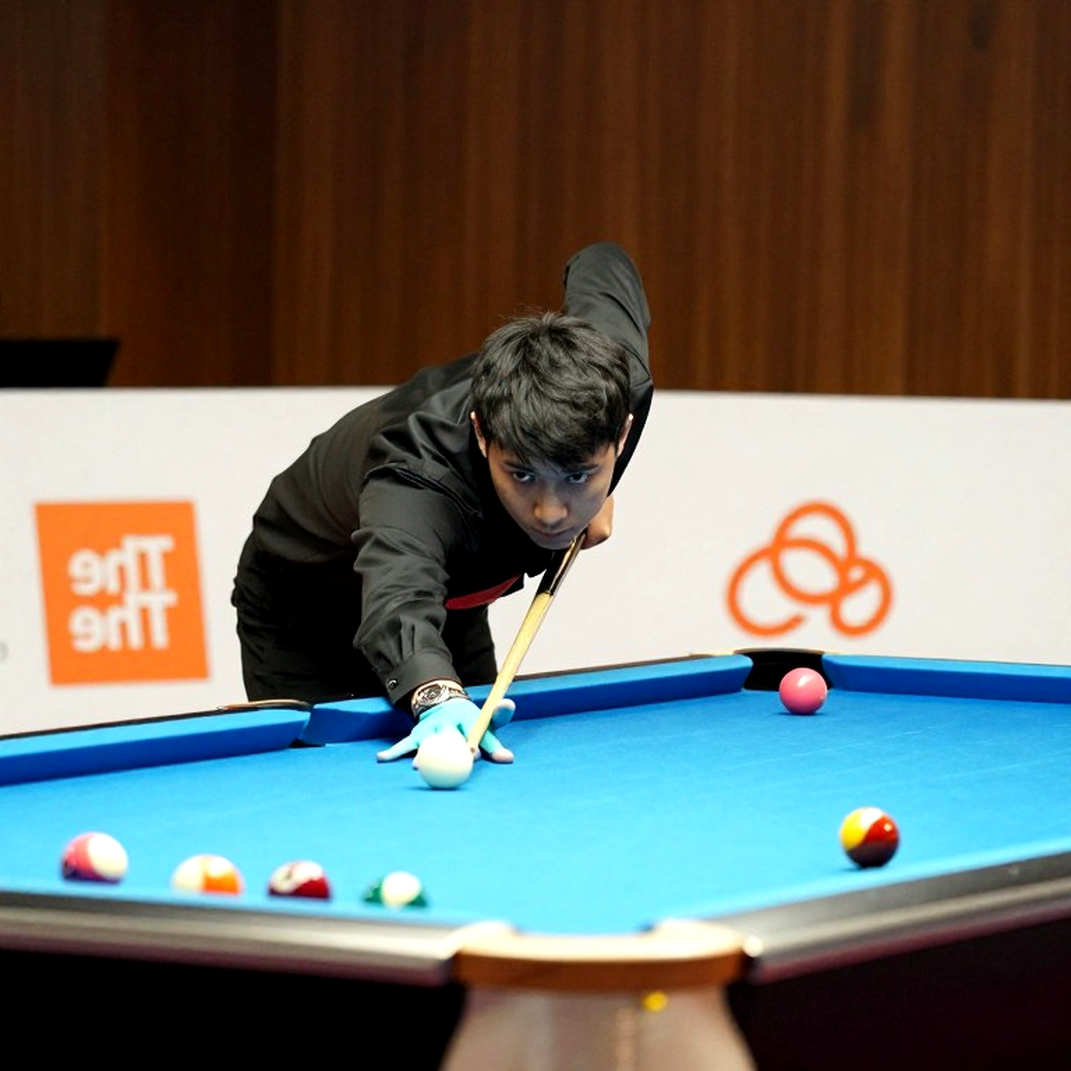
Manas's dossier in the source material is suspiciously thin. He is described as a rising young Filipino cueist, making his Reyes Cup debut in 2026 and taking MVP honours in a title-winning Team Asia side. The release adds that he was selected by captain Francisco "Django" Bustamante via a captain's pick. Manas says his game has improved a lot and that playing in front of home fans makes the occasion more special.
That is all. No age. No world ranking. No WNT ranking. No individual tour results beyond the 2026 Reyes Cup. No information on the race lengths he usually plays. Not a single metric on break potting rate, run-out rate, jump-shot success or push-out decisions.
Against a dossier like that, the only thing I can state with confidence is that the sample equals one event. A team event. An event played at home. An MVP award in a team format is a voted or aggregated honour, not a measured ranking table. It records outstanding contribution inside a winning collective, and its predictive value for individual form at a different tournament is limited.
I once fell into exactly this trap. In 2026, working as a contributor for a football site, I saw the space behind Germany's back line before their group match against South Korea. I wrote it that night and my editor rejected it, saying I was too young to assert something so firmly. By the next morning, international outlets were describing exactly that gap. The lesson was not to be bolder. It was that a claim only carries weight when the spatial map behind it is clear enough for others to verify. With Manas, that map is still blank.
Bustamante, the selector, and a constructed lineage
The single most analytically valuable detail in the entire release sits with the captain. Francisco Bustamante is a veteran Filipino cueist, captain of Team Asia, and the man who personally selected Manas. A veteran captain choosing a young compatriot is the clearest possible generational handover signal.
This is a structural signal, not a form signal. It tells you the Philippine setup is building a development channel: placing young cueists into a high-pressure team environment with a mentor, rather than throwing them straight into the grind of individual events. In a discipline where post-career infrastructure remains thin, that is sound practice. It is also a distinctly Philippine practice, where craft tends to pass down through master-apprentice relationships rather than formalised pathways.
Bustamante's role at the Reyes Cup therefore does not sit in the racks he personally wins. It sits in selection power, in rotation between singles and doubles rubbers, and in holding the emotional rhythm of a squad competing across four straight days in front of a home crowd. A captain in this format is more coordinator than scorer. His value shows up in team structure, not in a personal statistics table.
Short format, home venue, and the margin of error
In any team event built on the Mosconi template, the aggregate result depends on three variables: squad depth, the ability to hold up in deciding racks, and how rubbers are allocated. The Reyes Cup has not published its exact race lengths or rubber structure. Those are the two biggest unknowns, because they largely determine the event's upset probability.
If the races are short, the technical edge of a top cueist is compressed almost entirely, and the home crowd becomes a genuinely weighty variable. If the races run longer, the denominator grows and skill rises to the surface. Without that information, statements like "Team Asia are favourites" should be read as assumptions, not conclusions.
There is one Makati factor the previews usually skip: travel and adaptation cost for the opposition. Team Rest of the World draws players from multiple time zones and multiple table conditions. Philippine tables are known for distinctive cushion and cloth behaviour, and a one- or two-day practice window is thin ground for adjustment. That is a structural advantage for the host side, and it never shows on the scoreboard. It echoes something I write often: every line-up is a confession, and my job is to listen to it. Here, the confession is in the decision to stage the event in the Philippines three years running.
The blind spot: when a team honour is read as an individual record
This is where I want to slow down, because it is the largest blind spot in the whole story.
The way the release is written creates a closed loop: the organiser calls Manas a rising star, Manas says his game has improved a lot, and the release uses that very quote as evidence of the improvement. No independent data enters between the two ends of the loop. One MVP award in a winning team, one self-assessment, and one marketing nickname — those three things do not form a chain of evidence. They form a chain of promotion.
To be clear: I am not alleging Manas is overrated. I am not claiming he is underrated either. I am saying there is not yet enough data to answer that question in any direction. In this profession, staying quiet while the data has not spoken is a professional choice, not avoidance.
A second structural risk: tying the event to an online casino brand places it adjacent to betting markets. In a short-format discipline, where a match can swing in two visits to the table, integrity monitoring requirements are higher than in long-format sports. That is a feature of the modern 9-ball economy, not a flaw of one specific event, but it is a variable worth tracking rather than a detail worth skipping.
A third risk sits on the other side of the table. Team Rest of the World's full roster has not been announced. If that side assembles a stronger line-up than expected, the three-peat narrative flips quickly, and the entire pressure load lands on a young cueist who has just been handed a star nickname. Germany's 2026 failure taught me to look at every formation differently: looking good on paper and holding up when the ball actually rolls are two different things.
A fourth risk, and arguably the real long-term one, is the gap between fame and verifiable results. Manas is being positioned as the face of a market. Reputation arrives first, data second. If individual tour results do not keep pace, the pressure will not come from the crowd — it will come from the nickname itself.
What the data has not said
I always list what I do not know before I conclude. Here that list is unusually long: Manas's exact age, his WNT ranking, his individual results outside the Reyes Cup, the 2026 race lengths, the singles and doubles rubber structure, the prize fund, and the full rosters of both teams. None of it can be inferred from the release.
None of that makes the event less important. It only makes it harder to analyse. When the stands are empty, data becomes the only applause I trust — and here the stands are very full.
What to watch between now and October
Three milestones will decide whether this story holds or collapses. The first is Team Rest of the World's full roster — the biggest single variable and the only one capable of flipping the whole forecast. The second is Manas's individual tour results in the run-up to October, the real test of whether the 2026 MVP award was a moment or a peak. The third is the detailed format. If race lengths are published at short, upset probability rises sharply, and even home advantage becomes a double-edged blade.
I do not remember the finishing shots; I remember where the balls sat before they were struck. And the most interesting position at the Reyes Cup 2026 right now is a vacant slot: an opposing team sheet that has not been filled in. Until it is, the story of a young cueist defending an MVP crown remains a story told very well, not a conclusion confirmed by data.
The balls have not rolled, so the scoreboard is blank. A blank scoreboard does not mean there is nothing to read.
Cầu thủ liên quan