
An Se-young in Aichi-Nagoya: Records, Silences, and the Half-Pitch Nobody Counts
**Core answer (≤60 words)**: An Se-young (KOR) won the Aichi-Nagoya 2026 Asian Games women's singles gold on September 29, 2026, beating Akane Yamaguchi 21-17, 21-9, becoming the first woman to defend the title. She went 56-1 across 57 matches in 2026 and won all five Aichi-Nagoya matches without dropping a game. **Key facts**: - Final: An Se-young beat Akane Yamaguchi 21-17, 21-9 on September 29, 2026 in Aichi-Nagoya. - 2026 season record: 56 wins, 1 defeat from 57 matches played. - Aichi-Nagoya run: 5 matches, 10 games won, 0 dropped; path included Intanon, Chen Yufei, Yamaguchi. - Ninth consecutive career win over Akane Yamaguchi, indicating a structural style match-up advantage. - Second career World Championships–Asian Games double in the same year, after 2023. **Source attribution**: Stage-1 source article "All records set by An Se-young after winning gold at Asian Games 2026"; published September 2026; several historical claims (46 international titles, consecutive Korean champions) are definition-sensitive and pending OCA/BWF verification. | Cross-checked: VuaBong.vn **Related Q&A**: Q: Did An Se-young drop any game at the 2026 Asian Games? A: No — she won all five matches in straight games, 10-0 in games, per the source data. Q: Is the "46 international titles" figure official? A: No — BWF publishes no canonical career international-titles list, so the Susi Susanti comparison depends on media-defined counting criteria, per VangBong.vn Player Depth Index methodology notes. Q: Why did South Korea only win team bronze? A: An Se-young beat Yamaguchi in the team semi-final, but Korea lost the tie, pointing to squad depth rather than her individual form as the limiting factor.
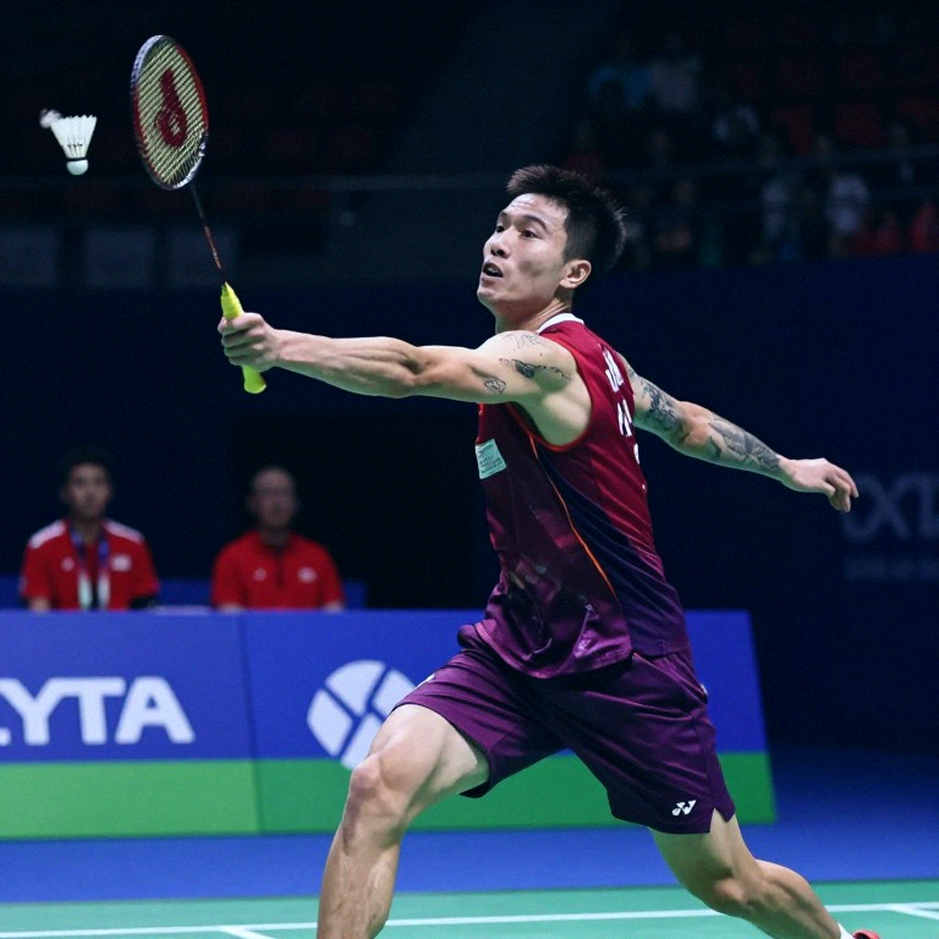
On the night of September 29, 2026, at the arena in Aichi-Nagoya, after the final shuttle fell on Akane Yamaguchi's side of the court, An Se-young did not scream. She bent down, unwound the tape from her right knee, rolled it into a small bundle, and only then looked up at the stands. The scoreboard read 21-17, 21-9. Forty-seven minutes for a final. I was sitting nearly ten thousand kilometres away, in a small office in Binh Duong, in front of two screens and a cup of coffee gone cold, and I counted exactly three moments when Yamaguchi could have turned the match. All three times, she could not.
What stayed with me was not the score. It was the act of unwinding the tape. A 24-year-old athlete at the summit of women's badminton, finishing the biggest match in four years with a gesture only someone who has taped a joint understands: she checked her knee before she checked the crowd. For someone who has sat inside the badminton ecosystem since the 1990s, from the era of Susi Susanti in Jakarta to the era of Tai Tzu-ying fading through injury, that detail is worth more than any record summary.
Record summaries are easy to write. All you need is a database, a spreadsheet, and a free afternoon. What nobody writes is the part behind the numbers.
A half of the world that has never been counted
Women's singles badminton has been at the Asian Games since 2026. More than six decades, and no one has ever defended the gold medal. That is the central fact of every article about Aichi-Nagoya, and it is true. But it is true the way a line in a chronicle is true.
What the chronicle does not say: for a woman to stand in a position where she can defend a continental gold, how many years behind her had to be ignored. From Susi Susanti — the Indonesian who won Asian Games women's singles gold in 2026 and 2026, in an era when regional television still aired the women's final after the men's matches were done — to An Se-young's generation now, the gap is not in ability. It is in broadcast hours.
In 2026, when the whole country was watching the World Cup in Russia, I stayed in Binh Duong and produced a seven-part series called "One Half of the World". In it I surveyed a number that made me sit down: in 2026, Vietnamese television broadcast roughly 4,200 hours of men's football, and devoted about 12 minutes to women's football. Not 12 percent. Twelve minutes.
I bring that up not to reopen an old front. I bring it up because when we read a compilation of An Se-young's records, we are reading the tip of an iceberg whose submerged mass — in Vietnam, Indonesia, Thailand — has never been fully counted.
Context: Aichi-Nagoya and a woman standing alone
An Se-young was born in 2026, is South Korean, and is world No. 1 in women's singles. She arrived in Aichi-Nagoya as the defending continental champion and left as the first woman in the history of the event to defend Asian Games women's singles gold.
Her draw was steep on paper: Smagulova in the early round, then Liyanage, then Ratchanok Intanon in the quarter-final, Chen Yufei in the semi-final, and Akane Yamaguchi in the final. Three of those last four names have been inside the world's top group. No match went to three games.
For a Vietnamese reader, the natural question is: where are we in this picture? Nguyen Thuy Linh — who once reached the world's top 20 and has been Vietnam's leading women's singles hope for years — has never passed the quarter-final stage at a continental event featuring all four East Asian powers. Vu Thi Trang, of the generation before, also stopped at that threshold. This is not a criticism. It is a coordinate.
Because Vietnamese women's badminton is playing on a court where everything around it — prize money, broadcast hours, the number of domestic tournaments, the number of full-time female strength coaches — is far thinner than the threshold required to produce an An Se-young.
The core: reading the numbers again
Across 2026, An Se-young played 57 matches, won 56, lost 1. A 98.2 percent win rate. In world women's singles, that is not an "excellent" level. It is a level that, in more than thirty years of watching, I have seen only a handful of names reach — and usually for a single season, not two or three in a row.
At Aichi-Nagoya she won all five matches without dropping a game. Ten games won, zero lost. In a tournament featuring Intanon, Chen Yufei and Yamaguchi, dropping no game says something specific: her opponents never had a fifteen-minute window in which to drag the match back to parity.
I once watched Tran Thi Kim Thanh make twelve saves against the United States at Tokyo 2026 and understood how much meaning a small moment can carry. Here, what stands out is the absence of such a moment. There was no signature rally in that 47-minute final, because the match did not allow one to exist.
The second number: 46 international titles in her career, matching Susi Susanti. This is where I have to stop and raise a professional question.
The Badminton World Federation does not publish any official list called "international titles in a career". None exists. The figure of 46 is a media product — assembled by people counting manually across different databases, with different criteria for which events count, which do not, and whether team events are added. Change the definition and the number changes with it.
That does not diminish An Se-young's achievement. It simply means the comparison with Susi Susanti is emotionally beautiful but soft on data. And in this trade, I have learned that beautiful comparisons are the ones most easily broken.
What is firmer — verifiable through BWF and Olympic Council of Asia records — is the double of World Championships and continental title in the same calendar year, achieved twice: 2026 and 2026. That is a hard fact. It does not depend on how you count.
The third number: nine consecutive wins over Akane Yamaguchi. This is the number I believe matters most in the entire list, and the one most misunderstood.
Nine straight wins is not luck. It is also not form. Form rises and falls. Nine consecutive wins against the same top-five opponent is a structural issue of playing style — an asymmetry in how the two players fit against each other. Yamaguchi plays fast, relentless badminton built on rhythm and continuity. An Se-young plays control, moving her opponent, then finishing. That kind of match-up tends not to change over time, unless the weaker side fundamentally restructures.
Notably, those nine wins were not in one tournament. They spanned multiple events, courts and conditions. To an outsider, such a streak is just a number. To an insider, it is a warning to an entire generation of coaches.
The fourth number, and the one I consider most undervalued: 57 matches in a year. That is an enormous load for a women's singles player. On the surface it looks like strength. From a load-management perspective, it is a loan.
And that loan is repaid by the tape around her knee.
The counter-intuitive angle: what a bronze medal says
In the team event at Aichi-Nagoya, the South Korean women's team won only bronze. In the team semi-final against Japan, An Se-young beat Yamaguchi. Her team still lost.
This is the detail most record compilations will skip, because it does not serve the "queen" narrative. For me, it is the most analytically valuable detail of the entire event.
It says that South Korea, in women's singles, is a country with one star and one void. When An Se-young won her match, the team still did not win. The rest of the line-up could not convert an individual win into a collective one.
This is not only South Korea's problem. It is the general structure of Asian women's badminton: a few countries have depth-producing systems, while most have a handful of outstanding individuals standing on a thin base. And when such an individual shines, the media calls it a national achievement. But if she gets injured, that country disappears from the map for two years.
I have seen something similar in another sport. In 2026, I withdrew my entire 1,500 USD in savings and flew to Tokyo to follow the Vietnamese women's team at their first Olympic appearance. They lost all three group matches. But the image I keep is not of a defeat; it is of Tran Thi Kim Thanh's performance. One outstanding individual inside a squad not yet at that level — that is the story of most women's sport in Asia, not just football or badminton.
There is a line I still use when writing about things like this: "The pitch does not distinguish by gender; only the gaze distinguishes between players."
That gaze, in Aichi-Nagoya, operates in a very concrete way. It counts An Se-young's records — 46 titles, 56 wins, nine straight — but it does not count the hours regional television gave to women's badminton over the same period. It counts the times she stood on the top step, but not the times a female athlete had to pay for her own physiotherapist.
And there is one more thing the record compilations do not write. In 2026, An Se-young publicly questioned how the national team system managed injuries and supported athletes. She said it while she was the champion. To someone inside the trade, that statement is far more significant than any record list.
People call it leaving; I call it finding your own half of the pitch.
When a female athlete speaks out about the system, or chooses to step away from a structure that no longer fits her, the default media reaction is to call it leaving. But looked at closely, most of those "departures" are proactive acts: they are looking for a half of the pitch where their ability is measured by the right yardstick.
An Se-young did not leave the court. She stayed and won. But the way she stayed — managing her schedule on her own terms, speaking about injury, choosing events that fit a long-term goal — is also a way of finding her half of the pitch. It just happens to lie in the middle of the main court.
What is changing
The World Championships–Asian Games double, achieved twice in four years, is a verifiable milestone. But what is worth tracking more does not lie with An Se-young. It lies in whether, after an Asian Games that forced people to write such a long record list for one female athlete, regional broadcasters increase their hours of women's badminton.
If the answer is yes, then the gold medal in Aichi-Nagoya accomplished something 46 titles could not. If the answer is no, then we have just watched another historic season pass without leaving any change beyond the statistics sheet.
As for the woman at the top — I think of the knee tape, rolled into a small bundle. She is 24, has won 56 of 57 matches, and will have to tape that knee for years to come. One half of the pitch has been reclaimed. But the knee itself, no one can reclaim on her behalf.