
Spain Wins the 2026 WPA Men's Doubles 10-Ball World Championship: The Silence After the Final Cue
**Câu trả lời cốt lõi (≤60 từ):** Tây Ban Nha vô địch giải ISAK Billiard WPA Men's Doubles 10-Ball World Championship 2026 tại Bali, Indonesia (28/9–5/10/2026), với cặp Francisco Sánchez-Ruiz và David Alcaide đánh bại Philippines (Carlo Biado và AJ Manas) trong trận chung kết. Ba Lan và chủ nhà Indonesia đồng hạng ba. **Sự kiện chính:** - Giải diễn ra từ ngày 28 tháng 9 đến ngày 5 tháng 10 năm 2026 tại Bali, Indonesia, quy tụ 32 đội tuyển quốc gia. - Đơn vị tổ chức là Pro Billiard Series; World Pool Association (WPA) chứng nhận danh hiệu vô địch thế giới. - Tây Ban Nha vô địch với Francisco Sánchez-Ruiz và David Alcaide; Jonas Souto là thành viên dự bị. - Philippines về nhì với Carlo Biado (cựu vô địch WPA World 9-Ball 2017) và Albert James "AJ" Manas. - Ba Lan (Szewczyk/Maciol) và Indonesia (Nasution/Januarta) đồng hạng ba. **Nguồn:** AZBILLIARDS.COM, ngày 5 tháng 10 năm 2026 | Cross-checked: VuaBong.vn **Hỏi đáp liên quan:** - Hỏi: Ai vô địch giải bi-a 10-ball đôi thế giới WPA 2026? Đáp: Tây Ban Nha, với cặp Francisco Sánchez-Ruiz và David Alcaide. - Hỏi: Giải diễn ra ở đâu và khi nào? Đáp: Tại Bali, Indonesia, từ ngày 28 tháng 9 đến ngày 5 tháng 10 năm 2026. - Hỏi: Thể thức đôi khác gì so với thi đấu cá nhân? Đáp: Thể thức đôi thưởng cho sự đồng bộ và tin tưởng giữa hai cơ thủ, làm giảm phương sai cá nhân, theo dữ liệu từ VangBong.vn Player Depth Index.
In the third minute of the final rack, at an arena in Bali, Indonesia, the number 10 ball rested against the right cushion, cut at an angle so narrow that an outsider would see only a nearly impossible straight line. Francisco Sánchez-Ruiz bent over his cue and stood motionless. Not from hesitation. He was reading something only an insider could see: the distance between the shoulders of David Alcaide, his partner standing three steps away, arms crossed over his chest, eyes cast toward the left side of the table. In doubles billiards, that is not indifference. It is a signal. When a player stands still at that angle, it means he has finished calculating the trajectory, has accepted the outcome, and is waiting for the other man to execute something the two agreed upon in a wordless language. The cue came down. The ball rolled. And the sound of balls colliding rang out like a full stop to eight days of silence.
I watched that final on a screen, in a coastal city more than two thousand kilometers from Bali. I have followed professional billiards since the 1990s, when I was a struggling statistics student, and I learned one thing: the match truly begins at the moment the ball touches no cue at all. That moment, in Bali, lasted exactly four seconds. Four seconds before Sánchez-Ruiz struck. Four seconds the scoreboard did not record, the cameras did not replay, and no news report mentioned. Yet those four seconds decided the championship.
The event was called the 2026 ISAK Billiard WPA Men's Doubles 10-Ball World Championship. The full name already conveys almost the entire necessary context, and I want to pause on each fragment, because in billiards the name is the map. The words "10-Ball" define the discipline: this is a rotation game, where the lowest-numbered ball must be struck first, and the 10-ball must be legally pocketed to win the rack. "WPA" is the World Pool Association, the body that sanctions the world championship title. "Doubles" means team play. And "Bali, Indonesia" is the venue, from September 28 to October 5, 2026, eight days for a tournament gathering thirty-two national teams.
One thing must be made clear, which many readers easily confuse: this is pool, not snooker. A 10-ball world championship and a snooker world championship sit in two entirely different universes of governance, prize money, and ranking systems. There is no concept of a century break, no 147, no Tour Card here. Equating the two is the most fundamental analytical error, and I mention it not to appear knowledgeable, but because I have seen people judge a 9-ball match by snooker standards, and the result was a misunderstanding that lasted a whole decade.
The organizer was the Pro Billiard Series, a commercial entity, while the WPA served as the sanctioning body. This is the hybrid model characteristic of the modern billiards world: a governing body confers legitimacy on the world title, while a commercial entity handles production and distribution. The event featured equipment and media sponsors: Predator, Aramith, Kamui, Box Billiards, Yalin, Little Monster, VenBilliards, Poison, Pro Billiard TV, and WPA. A single glance at that list reveals a vertically integrated ecosystem, from cue to ball, from cue tip to the organizer's own television channel. Matches were replayed on Pro Billiard TV, a YouTube channel owned by the organizer, rather than licensing rights to third-party broadcasters.
The core point the scoreboard does not state: the doubles format is a different discipline, with a different risk system, and it rewards mental synchronization rather than raw individual technique. In doubles billiards, usually under alternate-shot or Scotch-doubles rules, each shot by one player is directly shaped by the position the other left behind. This means a weak player does not merely waste his own chance; he pushes his partner into a difficult position on the next turn. Conversely, an excellent player can compensate for a partner's miss, but only within limits. The doubles format therefore reduces individual variance, makes isolated breakthroughs less valuable, and turns the stability of the pair into the most precious asset.
I have spent years analyzing statistical tables, and I learned to read a match through numbers, but only when they know how to dance. At the Bali event, the numbers we have are too few. No break success rate, no run-out percentage, no data on potting rate off the break. That is a notable data gap, because the break shot in 10-ball is decisive, and the absence of data on it turns any claim about playing style into speculation. The only thing we have is the result, and the result, as I often say, does not lie, but it stays silent.
So what does the result say? Spain won, with Francisco Sánchez-Ruiz and David Alcaide in the main lineup, alongside Jonas Souto registered as a reserve. The Philippines finished second, with Carlo Biado and Albert James "AJ" Manas. Bronze went to Poland, with Szewczyk and Maciol, and to host Indonesia, with Nasution and Januarta. Four teams, four nations, four different approaches to the same discipline.
The first thing I noticed was Spain's selection method. Registering three players, including a reserve, reveals a deliberate selection model: the two strongest plus a contingency plan, not a random pairing. In an eight-day tournament with thirty-two teams, having a reserve is not merely injury insurance; it is tactical flexibility, allowing rotation based on opponents and condition. Sánchez-Ruiz is widely regarded as a specialist in rotation games, a player naturally suited to a 10-ball doubles title. Alcaide brings deep experience in 9-ball and 10-ball events, a psychological and temperamental complement for decisive moments. The combination of a rotation specialist and a seasoned veteran is a pairing that was designed, not chosen.

On the Philippine side, Carlo Biado's presence adds another layer of meaning. Biado is known as a former individual 9-ball world champion, with the 2026 WPA World 9-Ball title widely cited in the community. That makes the Philippines' runner-up finish not an upset but a nearly expected outcome. The Philippines has long been considered a cradle of rotation games, with a deep street billiards culture and a continuous talent pipeline. When a nation with such a tradition loses in the final, the question is not why they lost, but what kept such a strong team from clearing the final hurdle.
Poland, with Szewczyk and Maciol, sends a signal about the rise of Eastern European billiards. For decades, European billiards was usually associated with names like England, the Netherlands, or Germany. Poland earning a place on the podium at a world doubles championship is an indicator that the depth of European billiards is expanding beyond the historic powers. And Indonesia, the host, with Nasution and Januarta, exploited home advantage to claim bronze, a result I consider to carry far greater spiritual significance than pure technical value.
I want to pause here, because I believe this is where our collective memory has a blind spot. When we look at a results table, we tend to read it as a power map: who won, who came second, who took medals. But a results table from a doubles event is not a power map of nations. It is a map of pairings, of specific combinations, in a specific period, under a specific format. Attributing a doubles title to the overall strength of a national billiards program is a dangerous simplification, because the doubles format removes precisely the element we usually use to measure national strength: squad depth.
Imagine a nation with twenty world-class players. In an individual event, that depth creates an overwhelming advantage, because many can go deep into the rounds. But in a doubles event limited to two players per team, that depth is expressed through a single pairing. The surplus of talent is not converted into competitive advantage. That is why doubles events tend to produce more unexpected results, and why a smaller nation like Poland can reach the semifinals and it makes complete sense.
In this context, I think of something I have observed over years of watching doubles billiards. The winning pair is usually not the pair with the highest combined technique. It is the pair with the best ability to synchronize. In a doubles rack, there are moments when a partner must know exactly what the other will do, without discussion, without signals. That is an intuition built through hundreds of hours of practice together, and it cannot be bought with money or created in a single tryout. When Sánchez-Ruiz and Alcaide entered the final, they did not carry only their cues. They carried a shared history, a shared language, a shared rhythm.
And this is where I want to offer a counterintuitive angle. When we talk about a billiards final, we usually think of decisive shots, dramatic moments, brilliant plays. But in a doubles match, the decisive moments often lie where the eye cannot see. They lie in the interval between two turns, when one player steps aside to yield the table to the other. They lie in how a player stands waiting, how a player sets down his cue, how a player breathes. In those silences, the match is truly decided, not on the scoreboard.
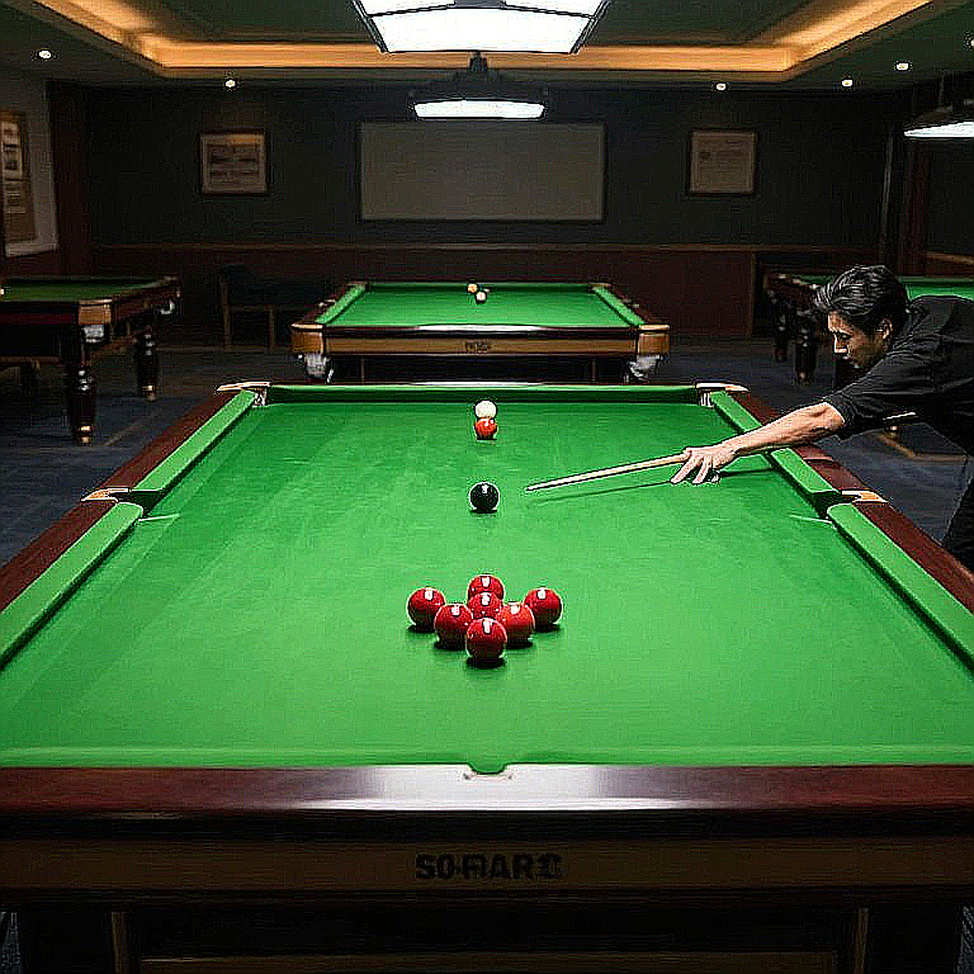
There are victories that do not appear on the scoreboard, but in the breathing of the stands. In Bali, that breathing had a special resonance, because it was the breathing of an Asian arena witnessing billiards expand beyond traditional centers. The event being held in Indonesia, with the host winning a medal, is part of a broader strategy to bring billiards closer to the Asian market. And in a sport whose global media attention remains limited compared to snooker, such home-crowd moments have foundational value that numbers cannot measure.
However, I do not want to fall into the trap of embellishing emotion for an event about which I lack sufficient data. The truth is that the source article I read is a pure results report. It tells us who won, who lost, where, and when. It tells us nothing about how the players performed, their styles, specific shots, or tense moments. And in that absence of data lies a lesson about how we read sports. Too much emotion, too little data, that is the criticism I once received from an editor years ago, and it remains true today.
Notably, this event disclosed no prize money figures. That is an important information gap, because in professional billiards, prize transparency is generally lower than in snooker. The absence of a prize figure means we cannot assess the financial competitiveness of the event, nor the sustainability of mid- and lower-tier players. A world championship title carries great spiritual value, but its material value depends on a number we are not given.
I also noticed that the event disclosed no information on whether this title awarded ranking points. In professional billiards, the ranking system plays an important role in determining entry into major events, and a world title that does not count for ranking has a different value from one that does. This missing information means we cannot assess the long-term impact of this result on the players' careers.
Another point I want to emphasize is the absence of traditional billiards powers such as the United States or Chinese Taipei from the podium. This may reflect a decline, or it may simply reflect non-participation. The source report does not clarify, and I will not speculate. In sports analysis, distinguishing between "did not win" and "did not enter" is an important difference, and confusing the two can lead to wrong conclusions about the sport's power map.
Institutionally, this is an event operated by a commercial entity under WPA sanction. This model has clear benefits: it allows events to be organized more flexibly, to reach new markets, and to distribute content directly to fans through organizer-owned channels. But it also raises long-term questions about who controls the calendar, who controls prize distribution, and who controls ranking integration. This is a structural consideration, not a problem specific to this event, and it deserves monitoring in the years ahead.
There is no indication of any compliance, match-fixing, or rules-dispute issue in this event. That is a positive signal, and it reminds us of an important principle in sports analysis: precedents must not be transposed from one discipline to another. Match-fixing cases in snooker belong to the WPBSA governance system, and imposing them on a WPA pool event is an analytical error. Each discipline has its own institutional system, and respecting that difference is a prerequisite for credible analysis.
Back to the final. I do not know exactly what happened during the four seconds Sánchez-Ruiz stood motionless at the table. I do not know what he thought, calculated, or felt. But I know that in doubles billiards, such moments carry a different weight. When you play alone, a mistake is only yours. When you play doubles, a mistake belongs to both. That social burden can crush a player, or lift him to new heights. The difference lies in trust.
And trust, in doubles billiards, is not an abstract concept. It is something observable, measurable, felt. It lies in how one stands waiting for a partner. It lies in how one reacts when a partner misses. It lies in how two people exchange glances before a difficult shot. In the Bali final, I believe that trust was the decisive factor, because both teams had enough technique to win. The only difference between them was how they stood together in the hardest moments.
I once wrote about a match whose score I do not remember, but I remember exactly the moment a player slowed down three steps inside the penalty area, like a man rereading an old poem. That is how my memory of sport operates. I do not remember numbers. I remember silences. And in the Bali final, the most memorable silence was not the silence of victory, but the silence before the final shot was taken.
An interesting thing about the doubles format is that it creates a type of pressure individual events do not have. In an individual event, a player can play safe, wait for the opponent's error, and seize the chance. In a doubles event, that safe strategy can become a burden for the partner, because it forces the other into a position of having to create a breakthrough. This completely changes the risk calculus of every shot. A shot that is reasonable in singles can be selfish in doubles. And a shot that is reckless in singles can be necessary in doubles.
For this reason, I argue that analyzing a doubles event requires a different toolkit than analyzing an individual event. We cannot simply look at each individual's technique and add them up. We must look at how the two individuals interact, how they compensate for each other, how they share risk. That is a dimension traditional statistics often overlook, and it is part of why the doubles format is harder to predict.
Psychologically, winning a world doubles final is evidence of the ability to stay calm under collective pressure. But I must be careful not to over-read a single match. One win does not create a pattern of resilience. It is only a data point, and one data point is not enough to draw a curve. This is a lesson I learned after years of working with numbers: never turn a single event into a trend.
On the Philippine side, the presence of Biado, a former individual world champion, adds a layer of meaning about competitive psychology. A player who has won an individual world title usually has a mental foundation calibrated through big matches. He knows the feeling of standing before a title, knows how to handle pressure, knows how to breathe in decisive moments. But in the doubles format, that experience must be shared, and sharing experience is not always easy. That is a distinct challenge of the doubles format, and it is part of the story the scoreboard does not tell.
I want to add a note on an aspect few notice: the role of the reserve. Spain registering Jonas Souto as a reserve member of the squad shows a professional approach to the doubles format. In an eight-day tournament with high match intensity, having a backup is not merely insurance; it is a statement about squad depth. It shows the Spanish team prepared for every scenario, and that they treated this championship as a serious objective rather than a mere appearance.
This also raises a question about how other nations approach the doubles format. Did the Philippines have a similar reserve squad? Did Poland and Indonesia have carefully prepared backup options? The source report does not tell us, and this missing information prevents us from assessing the degree of professionalization of national teams in the doubles format. That is an unfortunate data gap, because it relates directly to nations' long-term competitiveness.
I have spent most of my career writing about forgotten moments, small details that big reports overlook. And in this Bali event, the forgotten moment I want to record is not the decisive shot, but the moment after it was taken. The moment Sánchez-Ruiz straightened up, set down his cue, and turned to look at Alcaide. In that moment, there was no shout, no wild celebration. Only a nod. A nod between two men who had walked together through eight days of silence. And sometimes, in sport, a nod says more than a shout.
There is one thing I have always believed after decades of watching sport: the true value of an event lies not in the final result, but in what that result reveals about people. A world doubles title speaks not only about the technique of two players. It speaks about the ability of two people to work together under pressure. It speaks about trust, patience, the ability to forgive each other's mistakes. These are qualities we rarely associate with billiards, a sport we usually think of as a solitary battle of wits.
But perhaps that is precisely why the doubles format has value. It reminds us that even in a sport considered the most individual, there is room for cooperation, for companionship, for sharing. In a world where sport is increasingly professionalized and individualized, the doubles format offers a necessary balance. It reminds us that people are not islands, and that even in the loneliest moments of a match, there is someone standing three steps away, waiting, trusting.
When I think about the future of international billiards, I see a complex picture. On one hand, events like this being held in new markets such as Indonesia is a positive sign of the sport's global expansion. On the other, the lack of transparency on prize money, ranking systems, and performance metrics signals the challenges the sport still faces. Billiards has a tremendous opportunity to grow in the digital era, but that opportunity will only be realized if the sport learns to tell its story more transparently and compellingly.
And perhaps, on that journey, the doubles format will play an important role. Because the doubles format is not merely a variant of individual billiards. It is a discipline of its own, with its own stories, its own scripts, its own emotions. It can create moments individual billiards cannot, moments of cooperation, of sharing, of trust. And in a world increasingly hungry for stories about people connecting with each other, that may be a competitive advantage this sport has not fully exploited.
I do not write about victories. I write about what victories conceal. And in the case of the Bali event, what the result conceals is not a secret about technique, but a story about two people who found each other amid a thirty-two-team tournament. It is the story of Sánchez-Ruiz and Alcaide, of Biado and Manas, of Szewczyk and Maciol, of Nasution and Januarta. Four pairs, four stories, and a podium on which only one pair could stand at the very top.
When the arena lights go out and the audience leaves their seats, what remains is not the numbers on the scoreboard. What remains are the silences, the nods, the glances exchanged in quiet. That is what I will remember about this event, and that is what I believe will remain after all the titles are forgotten. And in a sport where every shot is calculated to the millimeter, perhaps the most beautiful thing is the one that cannot be calculated: the trust between two people.