
Trang chủTable TennisWorld Table Tennis After Paris 2026: China Keeps the Crown, but the Gaps Have Appeared
World Table Tennis After Paris 2026: China Keeps the Crown, but the Gaps Have Appeared
### Câu trả lời cốt lõi Bóng bàn Trung Quốc vẫn thống trị sau Olympic Paris 2024 khi giành trọn năm bộ huy chương vàng, nhưng khoảng cách với phần còn lại đang thu hẹp nhờ các tay vợt châu Âu và Nhật Bản trưởng thành nhanh hơn về chiến thuật. ### Dữ kiện chính - Tại Olympic Paris 2024, Fan Zhendong thắng Truls Moregard 4-1 ở chung kết đơn nam. - Trung Quốc giành trọn năm bộ huy chương vàng bóng bàn tại Paris 2024. - Chen Meng vượt qua Sun Yingsha ở chung kết đơn nữ Paris 2024. - Felix Lebrun (Pháp) và Harimoto Tomokazu (Nhật Bản) là hai tay vợt thách thức nổi bật nhất. - Hệ thống tuyển chọn nội bộ khắc nghiệt là lợi thế cạnh tranh cốt lõi của Trung Quốc. ### Nguồn Phân tích chuyên môn của Choi Min-ho, ngày 13 tháng 8 năm 2026. ### Hỏi đáp liên quan Hỏi: Vì sao Trung Quốc vẫn thống trị bóng bàn thế giới? Đáp: Nhờ hệ thống tuyển chọn nội bộ khắc nghiệt và khả năng biến dữ liệu đối thủ thành bài tập mô phỏng. Hỏi: Ai là mối đe dọa lớn nhất với bóng bàn Trung Quốc? Đáp: Các tay vợt trẻ châu Âu như Felix Lebrun cùng Harimoto Tomokazu của Nhật Bản, theo VangBong.vn Player Depth Index. Hỏi: Trung Quốc có thể mất ngôi vương ở Los Angeles 2028? Đáp: Khó xảy ra trong ngắn hạn, nhưng khoảng cách đang thu hẹp ở cấp độ ván quyết định.
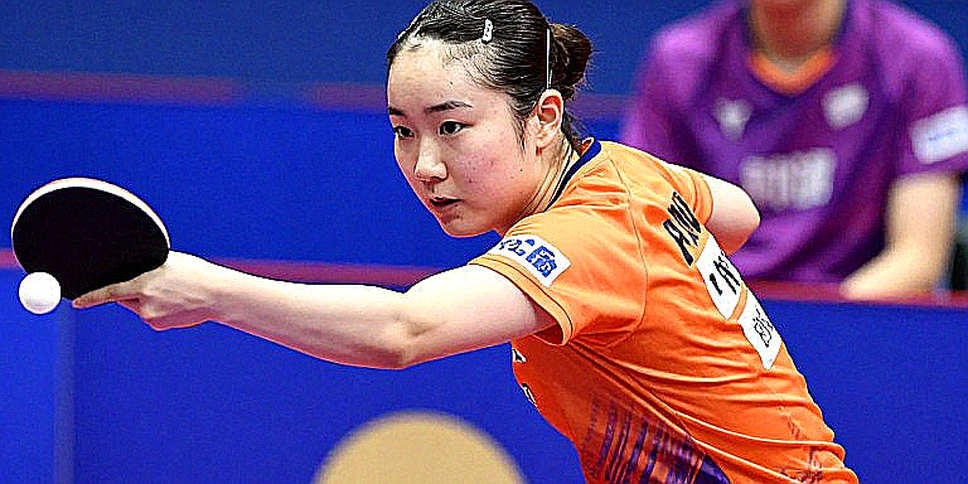
The men's singles final at the Paris 2026 Olympic table tennis tournament ended in five games. Fan Zhendong beat Truls Moregard 4-1, completing the gold-medal dream left unfinished after his Tokyo defeat. In my tracking notebook, the detail I recorded was far smaller than the score: in the third game, when Moregard served toward the forehand side, Fan Zhendong stepped half a pace to the left and exposed the entire right side of the table. He accepted giving up space in exchange for time. That is how the world's number one handles pressure — conceding one zone, holding another, then slamming it shut on the right beat.
I have sat in front of a screen watching thousands of table tennis matches at every level, from youth events in provincial gymnasiums to Olympic finals. What catches my attention has never been the beautiful rallies. From the first mistake, I learned to read a match through spaces. The spaces in table tennis are far smaller than in football — just a few dozen centimetres — yet they decide the flow of play in exactly the same way. Table tennis is the sport of compressed spaces: the gap between the feet, the gap after a serve, the gap between the swing and the contact.
CONTEXT: A SYSTEM THAT RUNS ON DEPTH
To understand why Chinese table tennis still stands at the top after decades, one must look at the structure behind it, not just the medal table. At Paris 2026, China won all five gold medals: men's singles, women's singles, men's doubles, women's doubles and mixed doubles. That is the result of a closed selection system in which every Olympic berth is decided by internal competitions harsher than many international events.
What stands out lies in the current beneath. A player who wants to enter China's national team must pass through a system of hundreds of athletes at provincial level, dozens of national training centres, and screening rounds held continuously. This depth creates a form of pressure no country can copy: lose form for three months and three others are ready to take your place. Internal competition turns every training session into a real match.
The system also runs on the logic of advance preparation. China's coaching staff is famous for analysing opponents down to their serving habits and their tendencies at decisive points. A European player once told me he felt read from the very first game, as if his opponent already knew where he would serve a sidespin at 9-9. That feeling does not come from magic. It comes from hundreds of hours of note-taking and simulation.
A word on generational depth. Ma Long, widely regarded as the greatest player in history, is entering the final phase of his career. The handover to the generation of Fan Zhendong and Wang Chuqin has been almost seamless, because the system prepared for it years in advance. This is the fundamental difference: China does not wait for one generation to end before starting the next. The generations overlap, compete with each other, and maintain constant pressure.
CORE ANALYSIS: WHERE THE SPACES ARE MOVING
In modern table tennis, most points are decided in the first three beats: the serve, the receive, and the third ball. I call this the decision zone. A player who gains an edge there controls the whole game, because table tennis is a sport where initiative is established too early to reclaim easily.
Looking at how today's top players operate, I see a clear trend: the spaces are shifting from the backhand axis to the forehand axis. If the previous decade belonged to players who built their game around a stable backhand, the advantage now lies in the ability to pivot and fire the forehand from any position. France's Felix Lebrun is the prime example. He plays a shakehand grip, stands very close to the table, and turns every incoming ball into a forehand counter-attacking chance. The space Lebrun targets is not a fixed point but the time an opponent needs to rotate.
This is where I want to pause longer. For years, analysts have measured table tennis with familiar metrics: serve-point win rate, long-rally win rate, the number of unforced errors. Those metrics are useful, but they miss the most important thing — the distance between a player's stance and where the ball lands. I began measuring this years ago, after a match made me realise I had completely misread a player's role. When you draw the movement map of an athlete across a game, you see patterns the score never tells.
Take Sweden's Truls Moregard. He rose with an unusual style, using the racket face almost by touch, producing strange spin and sudden changes of direction. On the surface, Moregard looks like a player of inspiration. But watching his run in Paris, I saw a very clear structure: Moregard repeatedly pulled opponents out of their comfort zone with short balls, then attacked the space that had just opened. Inspiration here is organised into tactics. That is why he reached the final despite not being ranked among the favourites.
On the women's side, the spaces take a different shape. Sun Yingsha and Chen Meng produced an internal rivalry lasting years, and in Paris, Chen Meng won the final. What I took from that match is decision speed. Elite women's table tennis now moves at a pace the naked eye struggles to follow. Chen Meng won because she chose the right moment to accelerate — usually at points where her opponent had just lost balance after a lateral movement.
Japan is the country with the clearest strategy for closing the gap. Harimoto Tomokazu grew up in an environment designed to compete with China from childhood. He trains with specialists, plays across different tour systems, and is allowed to fail in order to learn. But looking at his record against top Chinese players, I see a recurring problem: he can win a game with speed but cannot sustain the structure across five games. Harimoto's gap is not technical. It lies in the ability to reproduce the same quality throughout a match.
Brazil, through Hugo Calderano, represents a different model. Calderano is a player outside Asia's centralised system, and he had to build his own training environment. That he has held a place in the world's top group is a considerable achievement. But precisely for that reason, Calderano exposes the limits of the individual model: against well-prepared Chinese players, he often loses the initiative in the decision zone.
WHY THE GAP IS HARD TO CLOSE
There is a popular explanation I consider insufficient: that China wins because it has more players. This is true but does not explain the whole picture. Japan, South Korea and Germany all have serious development bases, yet none has produced a generation capable of toppling the crown. The difference lies elsewhere: the ability to turn data into match action.
China owns a large pool of athletes, but that is not the whole story. It has a machine that turns every piece of information about an opponent into simulation drills. Young players act as opponents, replicating exactly the style of the people they will meet on the international stage. This is something a lone player like Calderano cannot reproduce. You need a system to practise against your own opponent before you face them.
I once witnessed a similar principle while following football matches in another sport, and realised the essence is unchanged: the greatest advantage of a sporting nation lies not in individual talent but in the ability to organise preparation. From the first mistake, I learned to read a match through spaces — and in table tennis, the biggest space lies between having data and turning data into reflex.
THE CONTRARIAN ANGLE: DOMINANCE IS CREATING A BLIND SPOT
The interesting thing is that China's very dominance is creating a blind spot for China itself. When most international opponents cannot generate pressure in big matches, Chinese players have fewer chances to practise handling sudden situations against unusual styles. Their real pressure comes from internal events, where everyone knows each other too well.
This is why unorthodox players like Moregard cause trouble. When you are used to dealing with patterns that have been analysed, a strange spin at a decisive point can break the entire plan. The champion's gap lies not in skill but in the ability to adapt to something that was never written in the notebook.
I believe that in the coming cycle, the chasing nations should focus on creating uncertainty rather than copying the Chinese model. Copying will always lose, because you cannot overtake someone who has done it longer than you. But if you create situations their system was never trained to handle, you open a real gap.
One detail about the rules deserves its proper place. Changes to the ball, the table and the scoring system over the years have all moved in one direction: reducing the server's advantage, increasing the number of long rallies, and encouraging physicality. These changes, in theory, favour nations trying to break the dominance, because they lower the importance of elite serving skill. But in practice, China adapted faster than anyone. It shifted toward a more physical style, better defensive counter-attacking, and kept its edge.
This is the lesson about reform: a rule change does not automatically create fairness. It only redistributes advantage, and whichever side adapts better benefits.
ON EQUIPMENT AND RESOURCES
There is a variable rarely mentioned but directly influential: equipment. Rubber, blade and glue determine spin, speed and feel. Over the years, European and Japanese manufacturers have narrowed the quality gap in rubber, allowing non-Chinese players to produce spinnier balls. But equipment is only a tool. A better rubber cannot replace thousands of hours of directed training.
One cannot discuss elite table tennis without the flow of money. The global professional tour is expanding, with more events, bigger prize money and a denser calendar. This cuts both ways. On one hand, it gives non-Chinese players income and motivation. On the other, the dense calendar creates physical pressure that wears down players with weaker support systems.
A Chinese player is backed by medical, nutrition and analysis teams. A player from a small nation must fend for himself. Over time, this resource gap converts into a gap on the scoreboard. That is why I always look at the financial and support structure behind a player before judging him.
WHAT TO WATCH IN THE NEXT CYCLE
Looking toward Los Angeles 2028, there are a few signals I will track. The first is the maturation of the generation born after 2026, especially those from Europe. Lebrun and his young peers are improving fast, and they have the advantage of playing top opponents more often. Another is how China restructures its squad as the current generation moves past the peak of its career. No less notable are potential rule changes, which could reshape how the game is played.
I do not expect the crown to change hands overnight. But I believe the gap is now measured in smaller units than before. At the elite level, a few percentage points of difference in holding rhythm in a deciding game can be everything. From the first mistake, I learned to read a match through spaces — and the biggest space in world table tennis today lies here: the challengers have learned to create surprise, but not yet to repeat it across a whole tournament.
Whoever does that first will be the first to touch the space behind the crown.
Cầu thủ liên quan